
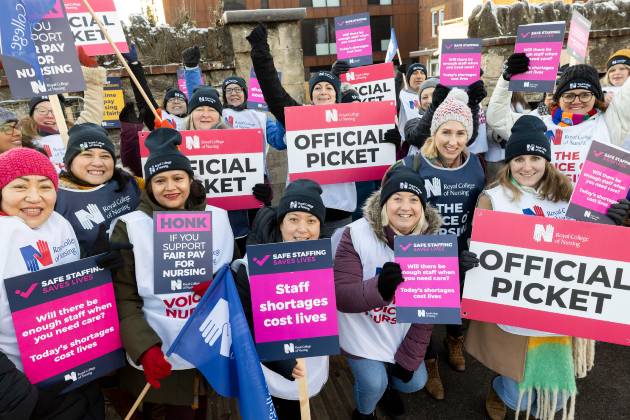
The news on 27th June that the Royal College of Nursing’s ballot of its members had failed to meet the 50% turnout threshold required by anti-trade union laws effectively brought to an end the union’s long-running dispute with the Government over pay and staffing shortages.
Activists within the RCN and the wider trade union movement took to social media to decry the fizzling out of what was, in the not too distant past, an ebullient and vibrant movement within the RCN as well as their fellow trade unions, laying the blame at the feet of the Government for pushing through Parliament the 2016 Trade Union Act, which introduced legal thresholds for strike ballot turnouts.
The Trade Union Act is a pernicious and reactionary piece of bourgeois legislation, one of a number of tranches of anti-working class laws to be enacted which drove the International Trade Union Confederation to downgrade the UK in its annual Global Rights Index, labelling the UK as a “regular violator of rights”, a label it shares with countries including Albania, Belize, Liberia and South Africa. It’s the first time in a decade that the UK has seen its rating drop, with the report stating that “union busting, attempts to introduce legislation curtailing the right to strike and protest and violations of collective bargaining agreements have become systematic” had led to the drop in the UK’s rating.
The authors of the report also said that the Government’s Strikes (Minimum Service Levels) Bill is being “rushed through parliament, and is another attack on the fundamental right to strike for workers in the UK, which already lacks constitutional safeguards and takes place in a draconian legislative environment for trade unions”.
But was the Trade Union Act in itself the reason for the RCN strike collapsing? The Act has been written into law for over seven years and many other trade unions over that time have held ballots and met the threshold – indeed ASLEF, the train drivers’ union, was one of the first trade unions to hold a ballot under the new law and was able to attain both a high turnout and a high vote in favour of strike action. We will look at two key reasons for the collapse of the RCN’s strike: The actions of the other trade unions in the NHS and the RCN itself.
The Government’s pay offer consisted of a one-off payment of 2%, a ‘Covid recovery bonus’ of 4% for the year 2022-2023, then a pay rise of 3% for this year with 1% pay rises for the next two years. Whatever angle one looks at this from, there is no way anybody could consider this offer anything other than totally derisory, way short of members’ expectations and way below the headline rate of inflation, with skyrocketing mortgage rates, food and fuel prices squeezing workers on a daily basis.
Yet RCN’s bureaucracy also initially agreed to this pathetic offer: We wrote a piece on this website which criticised the RCN for recommending its acceptance. The bureaucracy of the RCN had been dragged kicking and screaming into this dispute by their membership and were humiliated when, having recommended acceptance of the deal, were heavily criticised by their own members via social media, who then turned down the deal in a ballot. This schism between the trade union’s bureaucrats and the membership effectively sowed the seeds of the demise of the dispute and any opportunity for RCN members to find an agreeable settlement. But they were also undermined by other trade unions.
Members of Unison voted in April to accept the offer, with the union itself proclaiming that:
“We demonstrated how powerful NHS staff are when we all come together. We forced this hostile government to get around the table with us and present a better offer. Industrial action works. Direct negotiation works. This pay round has proved that for good. Now we build.”
That Unison could have the temerity to claim any credit whatsoever for negotiating this woeful settlement, let alone recommend it to their members, defies credibility. But Unison were not alone in accepting this wretched deal and undermining the RCN: The Royal College of Midwives and the Chartered Society of Physiotherapists also accepted the pay offer, leaving just Unite and the RCN as the outliers.
As the majority of the unions recognised by the NHS had settled, the portion of the pay deal which included an unconsolidated payment (the ‘covid recovery’ payment), would be paid into staff pay packets in June. Much like the well-worn employer tactic of imposing pay deals on their staff to suffocate class struggle, this inevitably killed the momentum that the RCN members had built up, both against the Government and their own union bureaucracy, following the rejection of the offer in April.
RCN members had been hit with a double whammy: Their own union’s bureaucracy recommended acceptance of the offer and every union except for Unite had collapsed into accepting it. But there was still hope for workers in the form of a new RCN ballot for strike, which sought to consolidate future industrial action by balloting the entire RCN membership in the NHS. The ballot would run for a full month and the RCN made a huge effort to get as many members as possible to return their ballot papers.

On June 27th, the RCN announced the result of the ballot. Only 43% of balloted members returned their papers, which meant that, despite the overwhelming vote in favour of further strike action, the ballot failed by dint of failing to meet the 50% threshold required by the Trade Union Act 2016.
Our sources within the NHS have informed us that many RCN members did not receive their ballot papers. One key issue in the modern trade union movement is that there are thousands of members whose personal details are not up to date, whether it be home addresses, employers or job titles. All of this information is vital for any trade union to navigate the myriad anti-trade union laws and, in a purely practical sense, for members to receive their ballot paper to vote. Trade unions should undertake what is called a ‘mapping’ exercise on a regular basis to keep their records up to date and the number of members who fall through the cracks to a minimum. Whether the RCN actually did this is not clear, but whatever they do in future to learn the lessons of the collapse of this dispute, how to keep up to date records must be one of them.
The members of the RCN have been badly let down in this dispute, not only by the other NHS trade unions who capitulated way before the RCN did, but by their own union’s bureaucracy, who recommended acceptance of the same wretched deal as Unison et al and, for reasons that aren’t clear, failed to agitate their members sufficiently to guarantee that their ballot would reach the 50% threshold required by anti-trade union legislation.
The Royal College of Nursing and the entire trade union movement must learn the lessons of this sorry story. A conflation of factors has meant that, yet again, an NHS pay dispute has ended in total defeat.

 Class Consciousness Project
Leave a comment