

Part 3: The Builders Strike
My first foray into the world of work was the usual paper round, with the nationals delivered on all seven mornings of the week, the Liverpool Echo delivered five evenings a week, as well as a meat delivery job for the Co-op after I’d done my papers on a Saturday. The lady who worked in the butchers always gave me a piece of liver or a couple of chops wrapped in newspaper. “Give these to your mum” she’d say with a wink.
I delivered the meat orders on a bicycle with a basket at the front, which was so hard to steer I fell off many times before I got the knack of it. I was expecting local dogs to be chasing strings of sausages flowing from my basket, like in the cartoons on television!
The town I lived in was booming, with many factories being built along the docks and the Mersey. Shell, Lobitos, Castrol, Carbon Black, Octel and Metal Containers just a few names, all sadly gone now. Vauxhall remains, but it doesn’t employ the numbers of men that it used to. When I was a young man, nobody in my town was out of work unless they chose to be.
I left school at 16 and within three days I was working for Crosville Buses in Aberystwyth in the parcels and information office. My uncle had got me in for the summer. It was a busy time as this was 1969 and the investiture of the English Prince of Wales in Caernarfon.
I hated school and school hated me. Even some of the teachers bullied the pupils, and from this I’d developed a deep-rooted abhorrence of bullies and bullying. My first ‘grown man’ job, even though I was seventeen and not on a full wage, was in Bowaters paper mill and it was like being at school: The bullying was rife. Fortunately, I was not subjected to any of this bullying, but other lads were, so I learned early on that if you don’t stand up for yourself, the bullies win.
It was an awful, dangerous job and my mother was forever telling me to be careful. I couldn’t wait to get out.
The first union meeting I attended was in the company social club. A SOGAT (the Society of Graphical and Allied Trades – a printing industry union) official was telling us about a possible closure of one of the three mills – that was in November 1970, and I was 17. The mill I worked in closed in April 1971 and I was free at last! My dad worked away on the building sites as a tower crane driver, but I was too young to get in that game, so I left home.
I landed in Portsmouth and got a job on the fairground in Southsea. Don’t ask me why or how! I messed around at that for a few months and really enjoyed it but returned home in September when the fairground closed down for the winter. I liked Portsmouth – it was a rough town, but it had character.
I was unemployed for three weeks and my dad was on a job in Flint, North Wales, operating the tower crane, so I went for a job there, starting at the bottom.
That block was completed, and we moved on to the two-storey maisonettes. I used to see old men up to their necks in trenches digging footings for 42p an hour, bent double at the end of the shift, and back then they worked sixty-hour weeks. Knackering. My dad had had an accident at work and broke his ankle. He never operated a tower crane again
We were all in the TGWU (the Transport and General Workers’ Union) on the erecting and the lads labouring were in UCATT (the Union of Construction, Allied Trades and Technicians). We didn’t have casual labour on our site.
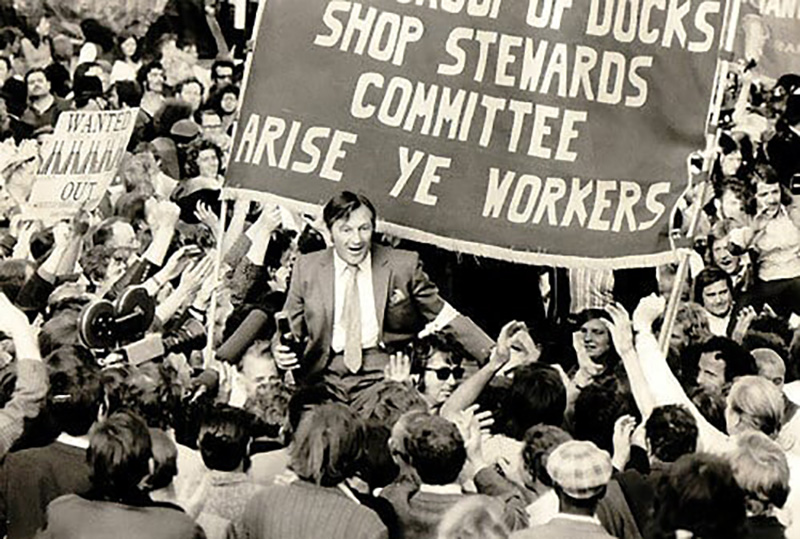
One day in June 1972, some lads came on site to tell us that a national strike had been called, the whole of Liverpool was out and would we support it. Of course, with most of my colleagues being from Merseyside, we downed tools put everything away and went. That was it for the best part of thirteen weeks.
I went on a few picketing duties, but I never saw any trouble like they did in Telford.
There we all were, standing on the RooDee, also known as Chester Racecourse, with a union official telling us to return to work. The vote was to return, so North Wales members went back to work. I voted against, but with the numbers we knew it was a lost cause and we’d been sold down the river by the union.
The job wasn’t the same when we went back. The ‘craic’ had gone and we just wanted to move on to the next job. I was expecting to go to a car park job in Liverpool City Centre, which would have suited me, but the gang was split up. So, I went to Stockport while the other lads went different ways. Two Scousers went to Manchester, the Wirral lads went to the car park, the Welsh lads went to Birmingham (I think). It was spiteful, but considering what they did after it was just the start.
The owners thought by splitting the men up they would break solidarity. They didn’t, because I just met other like-minded guys. I lasted four days in Stockport – never doing a tap because they’d taken my erectors job away from me and was finally shipped back to Flint where my old site agent was overjoyed to see me.
I was deemed surplus to requirements in April 1973 and paid off.
 Class Consciousness Project
Leave a comment