
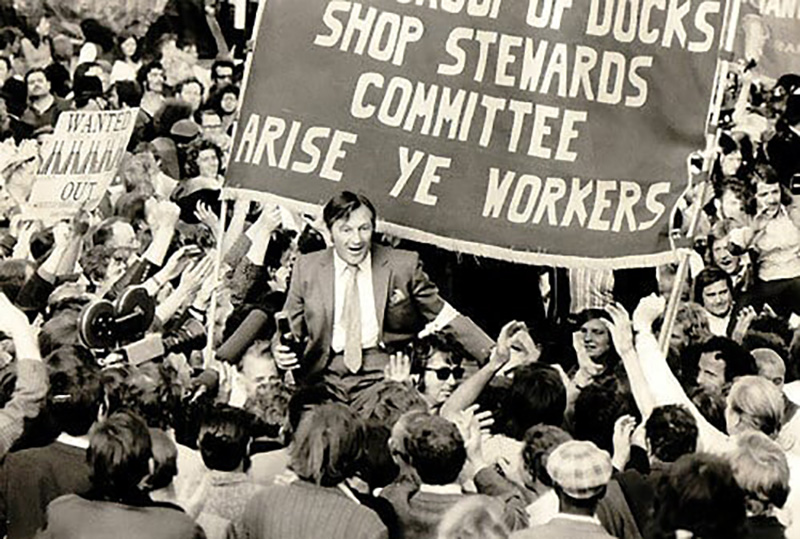

“The essence of neo-colonialism is that the state which is subject to it is, in theory, independent and has all the trappings of international sovereignty. In reality its economic system and thus its political policy is directed from outside.” – Kwame Nkrumah
Africa rising is more than a slogan; it is a new consciousness arising from the dramatic material changes happening in the Sahel which constitute a revolt against European neo-colonial extraction. In Africa imperialism is not only on the defensive, it is in full retreat. The continent has an enormous quantity of mineral wealth, but the population is largely poor, the continents wealth having long been extracted to feed the super profits of monopoly corporations rather than the African people.
Most of Africa was divided up in the ‘Scramble for Africa’ between 1884 and 1914 resulting in its almost complete control by European imperialist powers. Following World War II and the strength and example set by socialist USSR, African nations’ people began to challenge imperial control and demand sovereignty and so the ruling class set out to appease them. Their so-called independence, however, proved to be little more than flag independence, as the imperialists form of control shifted to neo-colonialism, a pseudo system that feigns sovereignty but financial control, mass exploitation and extraction of wealth continues. The deepening crisis of moribund imperialism combined with the re-emergence of a multi-polar world, marked by China’s rise to economic parity with the United States, Russia’s renewed assertion as a military power, and the consolidation of BRICS as a competing bloc to the US led imperialist order has shifted the global balance of forces. For the first time in Africa since the revolutionary wave of the 1960s and 70s, there exists sufficient counter-hegemonic strength to enable meaningful revolutionary pushback. In the Sahel resentment at the excesses of French neo-colonial exploitation, and the plague of Jihadi insurgents had made the region ripe for the military coups that took power with popular consent, leading to the founding of the Alliance of Sahel States (AES).
Alliance of Sahel States
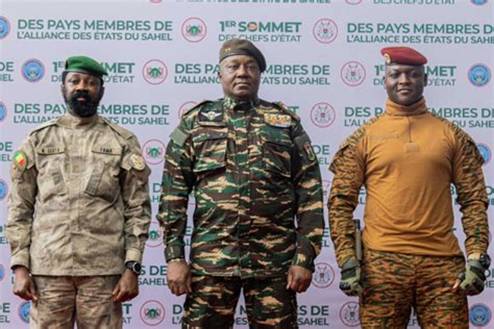
The Alliance of Sahel States was formed on September 16, 2023, when the leaders, Colonel Assimi Goita of Mali, Captain Ibrahim Treore of Burkina Faso, and General Abdourahamane Tchiami of Niger signed the Liptako-Gourma Charter formalising the alliance, and marking a decisive shift in the political and security dynamics of West Africa.
All three countries are former French colonies that gained independence in the 1960s. The new anti-imperialist leaders took power in military coups, Mali in 2021, Burkina Faso in 2022, and Niger in 2023 in response to decades of French neo-colonial influence and Western backed interventions, these states have rejected the dominance of France, as well as the Economic Community of West African States (ECOWAS), which they identify as tools of imperialism.
On 28 January 2024 the three AES states withdrew from ECOWAS. The AES represents an assertion of regional sovereignty and anti-colonial solidarity, taking its inspiration from the legacy of Burkinabe revolutionary Thomas Sankara. Its founding charter includes a mutual defence clause that declares an attack, military or economic, on one member as an attack on all. This came in direct response to ECOWAS sanctions and threats of military intervention following the Niger coup. The alliance expelled the French military from all three countries along with the US drone base in Niger, and signed a military cooperation partnership with Russia. On the 5 June 2025 The AES members signed an historic agreement for the three member states to formally combine and become one state, a state that will have a population of 92 million.
In May 2025 Chad, a state adjoining the AES eastern border, announced that is seeking membership of the alliance. In the same month, Togo‘s Foreign Minister Robert Dussey announced the states intention to seek closer ties with the AES. Chad is currently a member of ECOWAS, as is Ghana, another member state that is increasing its collaboration with AES , allowing AES to use Ghanaian port facilities would beneficial to both parties.
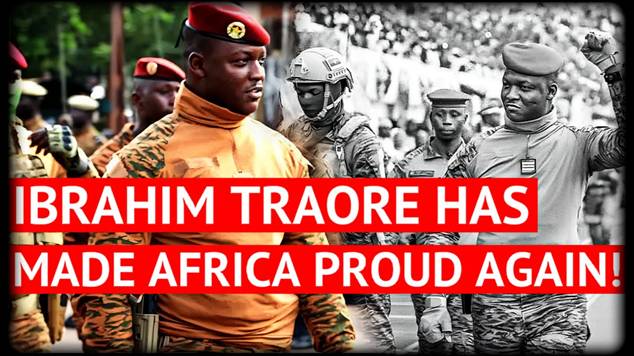
The future of ECOWAS, a community of states dominated by Nigeria, has to be in serious doubt as the national liberation consciousness generated by Ibrahim Treore’s inspirational leadership spreads amongst the regions masses.
The influence of BRICS in Africa is gaining momentum; South Africa, Egypt and Ethiopia are full members, while Nigeria and Uganda are partner states. Africa holds the material foundations for building a self-sufficient, sovereign economy. Realising this potential demands the full expulsion of European neo-colonialism and comprador elites, and the establishment of a planned, socialist path to economic development rooted in pan-African unity, and non dependent development.
A material validation of a pan- African renaissance is taking place; there has recently been an explosion of high tech inventions developing groundbreaking ideas on highly limited resources. To give three examples, the $5,000 EV from Mobius Motors in Kenya, that is building a basic but robust and affordable electric vehicle for the masses. Its battery technology is based on an iron-air matrix that uses aluminium, carbon, and air, no lithium, no rare earths, no toxic by-products, and no need for billion-dollar gigafactories. It stores 70% as much energy as lithium-ion but at just 10% of the cost. In Namibia, a teenager named Simon Petrus has invented a SIM-free mobile phone that doesn’t rely on SIM cards or telecom infrastructure. It uses radio frequencies to make free calls, send texts, and even transmit videos anywhere in the world, breaking away from the grip of telecom monopolies and their profit extracting networks. In Zimbabwe, Maxwell Chikumbutso has developed a car that never needs charging, petrol, or diesel; it is powered by a micro sonic energy device that converts radio frequencies into usable energy.
While the growth of African technological development is a hopeful sign, the key question remains: will this technology be harnessed for the benefit of the masses, or captured by corrupt self serving local elites, or sold off to foreign monopoly capital, thereby reinforcing the extractive, imperialist status quo? Such a path would obstruct the emergence of a sovereign, indigenous high-tech manufacturing sector.
In contrast, the example of Burkina Faso points to another possibility, one where planning takes precedence over profit, where the state plays a central role in coordinating domestic production using locally available resources. Treore has never claimed to be ideologically socialist, in practice his policies, such as the building of the Buma irrigation canal, using local materials and state finance, can only be labelled as socialist. Only socialism offers a model through which African nations can break free from imperialist dependence and its impoverishing parasitism, and instead build self-reliant planned economies that raise incomes and living standards for African workers.
Imperialism is in a deep crisis, it is facing ever worsening consequences of the crisis of overproduction brought on by the contradictions innate in capitalism, and the present crisis is no ordinary episode of market glut, it has been magnified exponentially by the technological shift brought on by the digital revolution and AI. As a result countries of the Imperialist core are lashing out in largely unsuccessful attempts to restore control and extend the geographical reach of their economic system, epitomised by the debacle of the conflict, both economic and military, with Russia over Ukraine. The imperialist grip on Africa is visibly in retreat.
The AES is at the vanguard of the anti imperialist fight back in Africa. It has lit the flame of rising revolutionary consciousness across the continent. What were once mere distant hopes is becoming a reality, inspired by Captain Ibrahim Treore and the AES, who in turn got their inspiration from great African revolutionaries before them such as Thomas Sankara and Kwame Nkrumah.
The African masses are awakening to the truth that change is not only possible, it is already unfolding. African nations are in the process of casting off the chains of neo-colonialism, depriving imperialist powers of their ability to control, disrupt, extract super-profits, and to exert control by having military bases on African soil.
The era of flag independence without political and economic control is ending and will be very difficult for the imperial core to reverse. The events set in train in the Sahel region is generating a materially grounded mood of revolutionary hope and optimism that neo-colonialism, what Kwame Nkrumah called the last stage of imperialism, could be on the verge of being driven out of Africa for forever.
 Class Consciousness Project
Leave a comment