
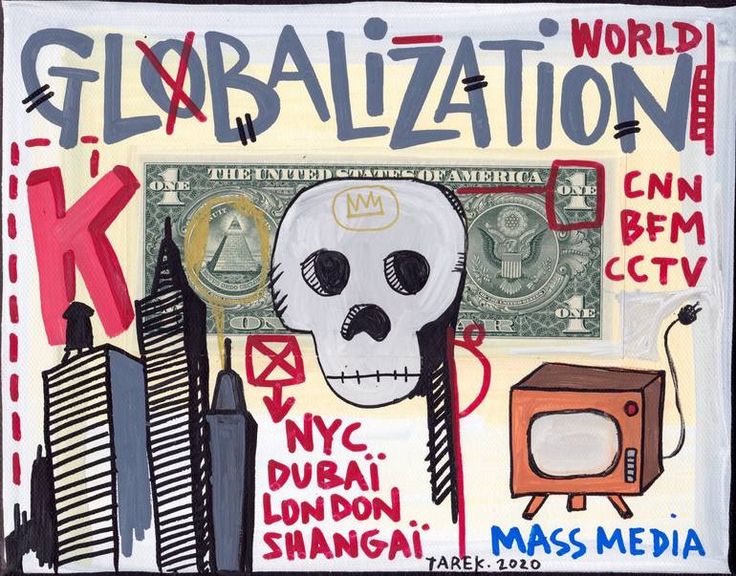
For many years now numerous online reactionaries have described the events unleashed by the imperialist bloc as being the product of so-called ‘globalism.’ Whether it is Alex Jones, Jim Ferguson, or David Icke, the term is thrown around constantly.
For many workers it is quite obvious that measures such as environmental laws or other state policies are being discussed and implemented by the ruling classes as a means of further oppressing the working class. Yet they do not always understand exactly why these laws are put in place or in whose interests they operate. So why are so many effects of capitalism being described as ‘globalism’? And why is this term used as a blanket description for processes that have in fact been going on for centuries?
Imperialism and Its Machinations
With capitalism in decline for over a century, the material conditions of life are deteriorating at an increasingly rapid pace. Many workers have noticed clear signs that something is deeply wrong: the rising cost of necessities, deindustrialisation, privatisation, war, and even the question of birth rates and ‘overpopulation’ (which I discussed in an earlier article Malthusianism the tactic of saving a dying-system)
There is no real way out for the capitalist class to save themselves. Nevertheless, capitalists have become increasingly obsessed with finding ‘solutions’ to the multiple crises facing them — even though the more cynical among them know such solutions are fruitless.
Despite this, countless media influencers — predominantly reactionaries, libertarians, anarchists, and even some who claim to take ‘anti-imperialist’ positions — promote the narrative that ‘globalists’ are taking over the world. Some claim that every political leader is on the same side. But how could they possibly pull off something this vast? They simply cannot. Especially now, with large sections of the working class in the West being beggared at every turn, anger is mounting — not least when workers hear talk of their children being drafted for imperialist wars.
So why is this narrative being pushed so aggressively? I see two main reasons:
- To spread pessimism and defeatism, even among those who consider themselves ‘revolutionary optimists.’
- To herd workers into the same dead ends as always — whether through anarchist calls to abolish the state’ or through reactionary electoral options like Farage or Le Pen.
While certain policies and schemes exist, we must ask whether the ruling class could actually carry them out. To do so would not only provoke massive anger from the working class but also cut into the very purchasing power on which capitalists depend. Hence, elements of ‘controlled opposition’ are deployed to redirect anger at one faction of the ruling class or another — for example, Reform UK painting Labour as the enemy, in order to attract votes.
The constant chatter of ‘globalism’ or ‘the Great Reset’ — a trap I myself fell into for at least two years — functions perfectly to pacify the working class for as long as necessary. Its apocalyptic jargon is designed to paralyse.
In truth, the system impoverishing the British working class is imperialism in its modern manifestations: privatisation (with BlackRock, Vanguard, and others buying up land and assets), billions in public money funnelled into Ukraine and Israel, and so on. None of this is new. Imperialism as a system has existed since at least the 1860s. As Lenin demonstrated in Imperialism: The Highest Stage of Capitalism, the issues workers face today are modern expressions of trends over a century old.
Imperialism: The Highest Stage of Capitalism
I will use two examples from Lenin’s work — monopolisation and war — to show that the problems workers face today are not new but have intensified in the century since Lenin wrote his classic text.
On Monopolisation
One of the biggest complaints of those who rant about ‘globalists’ is the concentration of ownership by financial giants like BlackRock. But monopolisation by banks and financial institutions is not new — it had already advanced significantly by 1916, when Lenin wrote:
“These monopolies are most firmly established when all the sources of raw materials are captured by one group, and we have seen with what zeal the international capitalist associations exert every effort to deprive their rivals of all opportunity of competing, to buy up, for example, ironfields, oilfields, etc.”
— Imperialism, Chapter VI: Division of the World Among the Great Powers
Since Lenin wrote those words 109 years ago, monopolisation has reached an even more advanced stage. One infamous example is the U.S. food industry, where ten corporations exercise near-total control over the food supply. As Lenin explained, monopolisation is underwritten by the banks, which finance takeovers and hold stakes in these corporations.
Many workers today are rightly disgusted by the fact that the products they buy are controlled by fewer and bigger companies. What the capitalist media never explains is that this process is not a recent conspiracy — it has been an organic feature of capitalist development for over a century.
On War
Lenin also wrote:
“The capitalists divide the world, not out of any particular malice, but because the degree of concentration which has been reached forces them to adopt this method in order to obtain profits.”
— Imperialism, Chapter VII: Imperialism as a Special Stage of Capitalism
As capitalist propaganda becomes ever cruder and more transparent, the question of war grows in importance. Workers look at the horrific scenes in Gaza and wonder: why does humanity tolerate such grotesque acts of destruction?
Reactionary fraudsters claim that wars are caused by shady cabals of ‘globalists’ who love war for its own sake or are simply ‘psychopaths.’ But Lenin’s analysis is both simpler and more horrifying: in its monopoly stage, capitalism requires the seizure of natural resources and markets.
Imperialist states — the U.S., Britain, France, etc. — pour money into militaries and intelligence agencies in order to secure these resources. War is therefore not the result of individual ‘bad actors’ but an inherent feature of monopoly capitalism.
Britain, the oldest imperialist power, depends heavily on the profits of the great monopolies headquartered there, and the British state consistently backs them in their global ventures. This explains why the U.S. and British governments are constantly at war: it is an endless scramble to secure profits for their monopolies.
Conclusion
Do Lenin’s words — written over a century ago — not sound eerily familiar today? Monopoly capitalism has only decayed further since then, whether in Starmer’s Britain, Merz’s Germany, or Trump’s USA.
So why do so many critics call this system ‘globalism’ rather than imperialism or capitalism? Two main reasons:
- Reactionaries and libertarians, who admit they are defenders of capitalism, cannot call the system by its real name without exposing their own role in defending it.
- Left-liberals who use the term often yearn for a return to the post-1945 social-democratic settlement. But such concessions to workers were themselves made possible only through imperialist exploitation. With Britain and other imperialist powers now far less able to plunder the world, their capacity to offer concessions has vanished.
Lenin wrote Imperialism during World War I, and the wars of his time — like today’s — were fought because imperialist powers competed over resources and colonies to establish dominance. The capitalist classes will always sell out even their closest allies for a greater share of profit. That reality alone demolishes the conspiratorial narrative of a unified ‘new world order.’
We must stop running into dead ends. We must explain Marxism-Leninism clearly and build a strong communist party capable of guiding the proletariat to revolution. Such a party can both explain the crises of imperialism and show how to abolish the contradictions of capitalism itself.
Only by understanding the nature of monopoly capitalism — imperialism — can workers fight back, overthrow the monopolists, and build a world where our class holds power.
 Class Consciousness Project
Leave a comment