
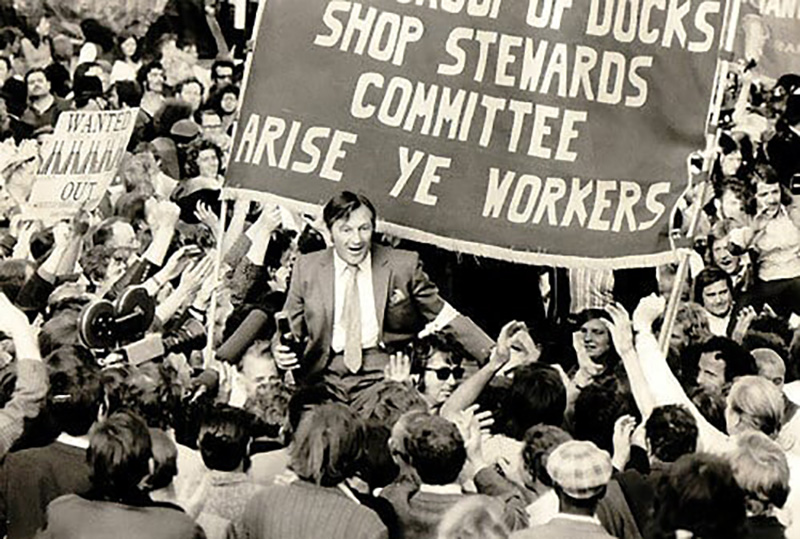

The election of Alex Gordon as General Secretary of the Communist Party of Britain (CPB) represents nothing more than grim continuity of agenda—a consistency this revisionist political outfit has maintained since its re-founding in the late 1980s.
We must emphasise “re-founded” here because, unlike the CPB’s own self-perception, we must recognise the reality: they are not the continuation of the old Communist Party of Great Britain (CPGB). Rather, they constitute a split away from the bankrupt revisionist core of that party in the late 1980s. Unfortunately, rather than founding a new revolutionary organisation and carrying forward the positive elements of the old CPGB, they essentially maintained the trajectory the CPGB had pursued since adopting the so-called British Road to Socialism in 1951—that of a party organically linked to the Labour Party and the trade union bureaucracy.
The Bureaucratic Character of the Leadership
The elevation of Alex Gordon to General Secretary is entirely appropriate given his background as a long-serving senior official with the Rail, Maritime and Transport Workers Union (RMT). This appointment reflects the CPB’s fundamental social base. They are not, in essence, a working-class party but rather a formation rooted within the trade union bureaucracy. It is therefore fitting that a trade union bureaucrat should lead them.
This represents continuity in perspective. Following the tradition of the former CPGB, the CPB seeks to serve as the left wing of a social democratic government—historically the justification for their backing of the Labour Party. While they now flirt with other political forces—the Greens, or the already-bankrupt Corbyn vehicle laughably titled “Your Party”—they maintain the same fundamental approach. This is not a party of working-class militants, nor one dedicated to class struggle. It is a party of the labour aristocracy and trade union bureaucracy, aimed at securing reforms within capitalism.
The Parliamentary Illusion
They are absolutely open about this fact. They do not regard the British working class as a revolutionary agent. Their sole ambition is to proceed down the parliamentary road to socialism—a phrase coined over one hundred years ago that leads only to a dead end, quite deliberately so.
The tragedy of both the CPB and its predecessor, the CPGB, lies in the transformation of what should have been parties of the revolutionary vanguard into merely left social democratic fronts with communist aesthetics.
Pacifism and Imperialism
This character permeates all their political approaches, including their position on war. The CPB does not understand war as a natural manifestation of imperialism; instead, they present it as a moral failing. This stems from the pacifism of the old CPGB, heavily influenced by Khrushchev’s revisionism.
They view class war as secondary to electoral politics, prioritising the election of a “left government.” Given the advanced decay of British imperialism and the impossibility of meaningful reforms, this commits the CPB to tail-ending whatever social democratic party currently dominates—whether the Labour Party under Andy Burnham (who has merely dropped some of the more obnoxious messaging of the Keir Starmer era), the Green Party under their retired hypnotist Zack Polanski, or Jeremy Corbyn’s latest project.
What they will never do is act as a vanguard for the most militant sections of the working class, mobilising the class against its enemies. This is not the commitment of the CPB, nor was it the commitment of former General Secretary Robert Griffiths, nor is it the commitment of the current General Secretary Alex Gordon.
Conclusion
This is continuity: wretched social democracy with Communist Party aesthetics. It is no surprise that the working class of this country wants absolutely nothing to do with it.


 Class Consciousness Project
Leave a comment