
From Industrial Power to Imperial Begging
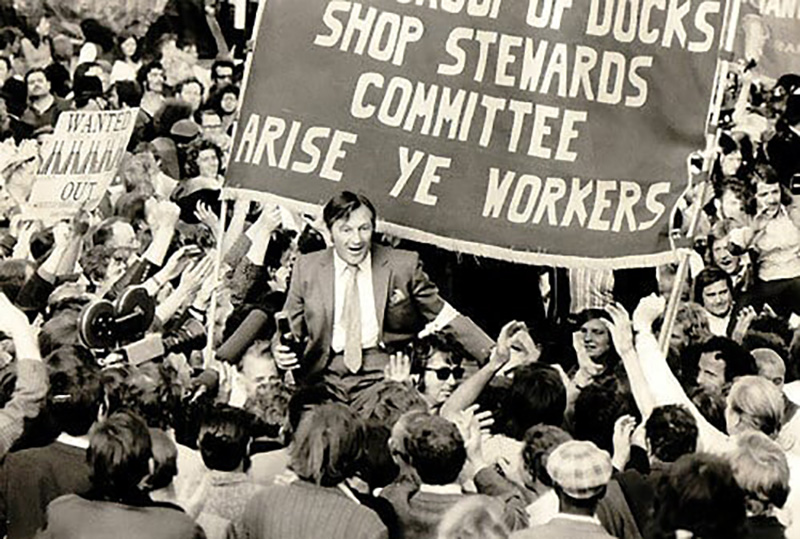
The deindustrialisation of Britain has wrought devastation upon the trade union movement that extends far beyond mere numerical decline. This process, accelerating from the mid-1960s onwards, has systematically dismantled the traditional industries that once formed the backbone of working-class organisation and industrial power. The consequences have been profound: secure, well-paid, dignified employment in manufacturing and resource extraction has been replaced by insecure, low-paid, hyper-alienating service sector work, while the trade union movement has undergone a qualitative transformation from organisations of productive labour to bodies increasingly representing non-productive service sector workers.
This structural transformation has produced an even greater atmosphere of profound conservatism within union leaderships—a conservatism born of desperation to preserve what little manufacturing base remains, even at the cost of class principles and international solidarity. It must be stated that there were always strong elements of this within the union leadership but that the defeats and disasters of the last fifty years have made this even more pronounced. Nowhere is this more evident than in the recent utterings of Sharon Graham, General Secretary of Unite, who has emerged as perhaps the most vocal advocate for increased military spending within the British labour movement. Her demands that Keir Starmer fulfil pledges to expand defence expenditure—justified on the grounds of preserving manufacturing jobs—represent not a strategy for working-class advance, but its opposite: a self-defeating accommodation with imperialism that strengthens our class enemy while offering crumbs to a privileged minority.
The Scale of Deindustrialisation: A Catastrophe in Numbers
To understand the desperation driving Graham’s politics, one must first comprehend the magnitude of industrial destruction Britain has witnessed. The steel industry, once employing 323,000 workers in 1971—representing 1.5% of the entire workforce—had collapsed to just 34,500 by 2014, a mere 0.1% of the workforce . This represents a decline of nearly 90% over four decades. The 2015-16 crisis alone saw the closure or reduction of capacity at major plants in Redcar, Scunthorpe, Scotland and South Wales, with UK steel production falling to its lowest level since 1933 . Britain, which stood as the world’s fifth-largest steel producer in the late 1960s, had slipped to 21st position by 2016 . It must be stated at this stage though that the Unite leadership (then under Len Mcluskey) took no serious action over these closures other than telling workers to “Vote labour”. At each stage when more militant action could have been taken to defend steel workers jobs the Unite leadership has deliberately chosen a line of weakness and passivity in the face of attacks by the ruling class.

The shipbuilding industry tells a similar story of managed decline. British shipyards, which produced 60% of world tonnage in 1924 and more than the rest of the world combined immediately after 1945, saw their share fall to just 0.01% of commercial ship tonnage by 2024—effectively zero in 2022 and 2023 . The nationalisation of 1977 and subsequent privatisation did nothing to arrest this collapse; between 1975 and 1985, UK shipbuilding output declined by nearly 90% .
Most catastrophic of all was the destruction of the coal industry. In 1981, the coal industry employed 229,000 men in English and Welsh coalfield areas alone, accounting for almost exactly one in four of all male jobs in these regions . By 2005, the privatised industry employed fewer than 7,000 in total, of whom only 4,000 worked at the eight remaining collieries . Between 1980 and 1994, more than 200,000 miners lost their jobs—a reduction of approximately 90% of the industry’s workforce . The socioeconomic impact was devastating and persistent: displaced miners experienced wage drops of around 40% in the first years after job loss, remaining 20% below pre-displacement levels fifteen years later, with overall earnings falling by 80-90% immediately after displacement .
The Transformation of Trade Union Membership
This industrial destruction has fundamentally altered the composition of the trade union movement. In 1979, trade union membership reached its peak of 13.2 million; by 2024, this had fallen to 6.4 million—a decline driven overwhelmingly by the private sector . Private sector union membership stood at just 2.5 million in 2024, down 57,000 from the previous year and the second lowest level since comparable records began in 1995 . The proportion of private sector employees who are union members fell to just 11.7% in 2024, the lowest on record .
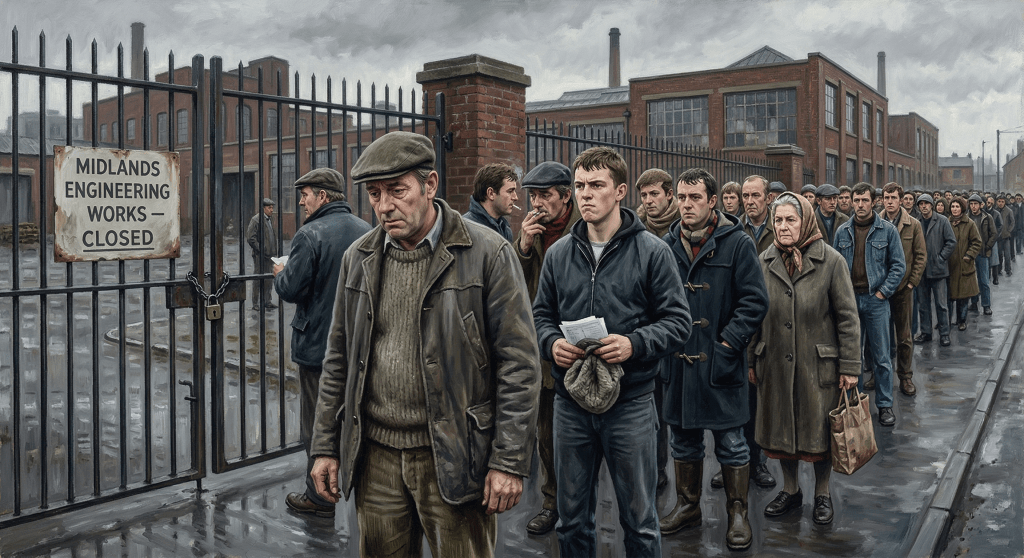
The contrast with the public sector is stark: 49.9% of public sector employees were union members in 2024, compared to 11.7% in the private sector . Manufacturing, once the heartland of union power, saw union density of just 30.4% in 2024—far below the 45% in Education and 42.3% in Public Administration and Defence . The number of manufacturing workers who are union members has collapsed to approximately 331,000 in 2024, compared to 1.45 million in earlier periods .
This shift has changed the sex composition of union membership. Female employees now constitute the majority of union members (3.7 million compared to 2.7 million male members in 2024), a reversal driven by the decline of male-dominated manufacturing and the growth of female-dominated public services . Male union membership has fallen to its lowest level since 1995, driven by the destruction of industrial employment .
The qualitative transformation is clear: the union movement has shifted from representing workers engaged in productive labour—directly involved in commodity production and resource extraction—to representing workers in non-productive service sector employment. This has profound implications for industrial power and political orientation.
Sharon Graham and the Logic of Military Keynesianism
It is within this context of industrial devastation and union decline that Sharon Graham’s advocacy for increased military spending must be understood. In February 2026, Graham issued a statement demanding that the Treasury relax fiscal rules for defence investment, declaring: “Keir Starmer promised when he announced defence spending that it would be good for British growth, British jobs, British skills and British innovation. This promise has not been kept”.
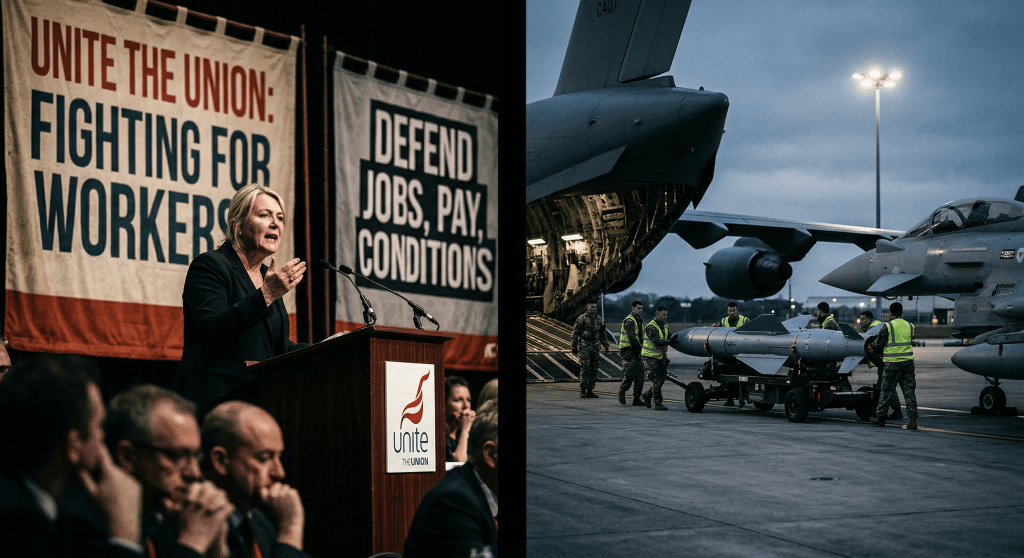
Earlier, in February 2025, Graham had been even more explicit, stating: “One year ago today the prime minister promised that increased defence spending would translate into British jobs, British skills, British growth and innovation. This promise has not been kept” . She characterised the Treasury’s delay to promised defence funding as “the latest in a long line of bad decisions” and an act of “self-harm” on the country’s defence sector .
This intervention was accompanied by a petition from “nearly ten thousand workers” urging the government to invest in domestic manufacturing, and a protest by hundreds of defence and aerospace workers at Westminster . Union officials at Leonardo, a major defence contractor, wrote to the Prime Minister warning that “a delay to a firm procurement decision until March risks the irreversible loss of critical skills, the dispersal of specialist engineers and the hollowing out of a sovereign industrial capability” .
Graham’s logic is transparent: military spending creates unionised, relatively well-paid manufacturing jobs in an economy that has systematically destroyed such employment elsewhere. The defence sector—encompassing aerospace, shipbuilding (now predominantly military), and advanced engineering—represents one of the last bastions of manufacturing that maintains significant union presence. From this perspective, demanding increased military expenditure appears as a rational defence of members’ interests.
Why This Logic is Self-Defeating
Yet this logic is profoundly self-defeating, and its self-defeating nature operates at multiple levels. First, and most fundamentally, it misunderstands the nature of the British state and its military apparatus. The purpose of increased defence spending, as pledged by Starmer and previously by Sunak, is not to create jobs for workers but to enhance the British ruling class’s capacity for imperial intervention. The retooling of the British armed forces serves a specific geopolitical function: the projection of power into Ukraine, into West Asia (particularly against Iran), and ultimately as part of the broader strategy of aggression against China.
This is not speculation. The strategic defence review commitments to reach 3% of GDP in the early 2030s and 3.5% by 2035 are explicitly oriented toward great power competition . The “sovereign industrial capability” that Graham seeks to preserve is, in reality, the industrial base for imperialist aggression. When British workers build Typhoon fighter jets or naval vessels, they are not producing use-values for social need but instruments of death and domination to be deployed against oppressed nations.
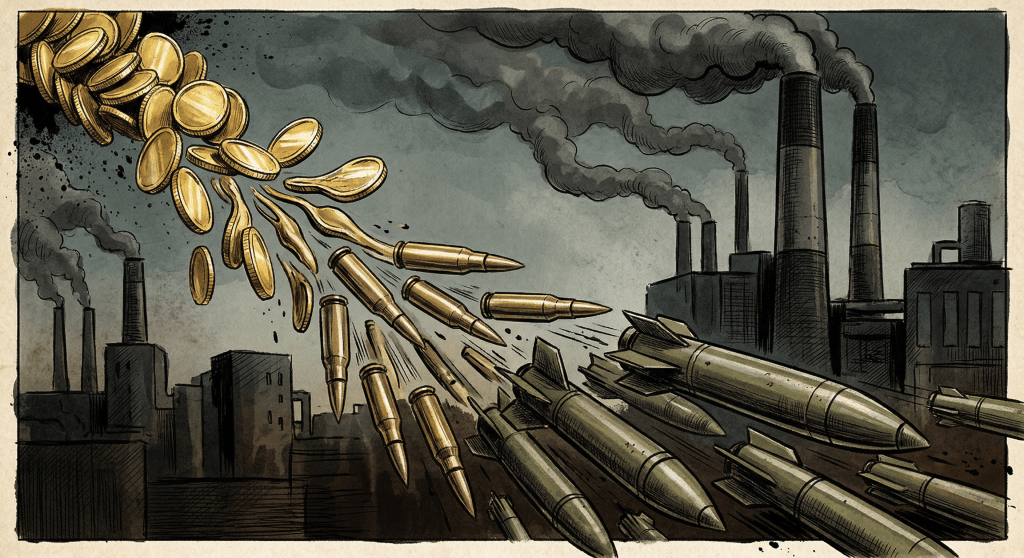
Marx observed that dead labour weighs upon the living—that capital accumulated through generations of exploitation becomes the means of oppressing new generations. So too with imperialist plunder: the profits extracted from the hyper-exploitation of workers in targeted nations and the asset-stripping of their economies serve not to benefit the British working class as a whole, but to sustain the British ruling class in its dominant position. Any crumbs that fall to the labour aristocracy through military Keynesianism come at the cost of strengthening the very system that deindustrialised Britain in the first place.
The second level of self-defeat concerns the nature of the “jobs” being defended. Military production is inherently parasitic—it produces no social use-value, only destruction. Moreover, these jobs are dependent upon the continuation of imperialist aggression—without wars and the threat of wars, the demand for these products evaporates. The union movement thus finds itself structurally aligned with the most aggressive, fascistic and militaristic sections of the British ruling class.
Third, and most dangerously, this orientation divides the working class internationally. When British union leaders demand military spending to “protect British jobs,” they implicitly accept the framework of imperialism that pits workers against each other along national lines. They abandon the principle of international working-class solidarity in favour of a narrow, bourgeois nationalist economism that serves the interests of “their” ruling class. The union leaders thus endlessly repeat the betrayals of the second international who backed “their” ruling classes at the start of world war one condemning a generation of workers to slaughter.
A Revolutionary Alternative
Against this conservative, self-defeating orientation, we must recall the words of Joseph Stalin in his 1924 work Foundations of Leninism. Summarising Lenin’s theoretical contributions on the national and colonial question, Stalin wrote:
“The interests of the proletarian movement in the developed countries and of the national liberation movement in the colonies call for the union of these two forms of the revolutionary movement into a common front against the common enemy, against imperialism… the victory of the working class in the developed countries and the liberation of the oppressed peoples from the yoke of imperialism are impossible without the formation and the consolidation of a common revolutionary front.”
This was not mere rhetoric. The Second Congress of the Communist International in 1920 formally updated the slogan from “Workers of the world, unite” to “Workers and oppressed peoples of all countries, unite”—recognising that the struggle against imperialism required the active alliance of the imperial core working class with the colonised and oppressed nations .
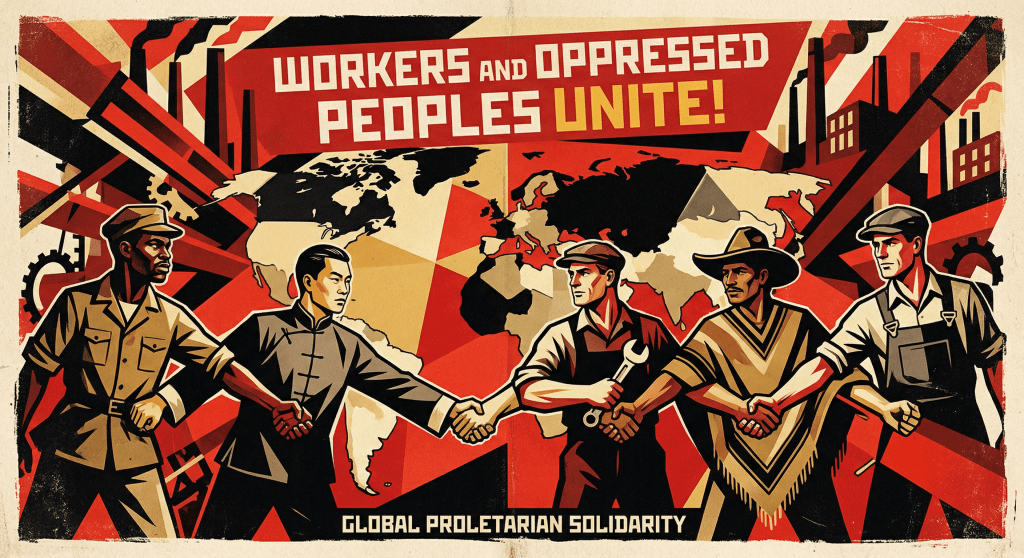
Stalin’s formulation cuts directly against the logic of Graham’s position. The Unite General Secretary seeks to secure marginal benefits for a section of British workers through complicity with imperialism; Stalin insists that the interests of the working class in developed countries are inseparable from the liberation of oppressed peoples. There can be no genuine working-class advance in Britain while British imperialism continues to dominate and exploit the Global South. The crumbs offered to defence workers are paid for with the blood and resources of oppressed nations—and this payment strengthens the chains that bind all workers.
The Historical Continuity of Union Conservatism
It must be stated that Graham is entirely consistent with her predecessors at Unite. Len McCluskey, her predecessor as General Secretary, pursued essentially the same politics—defending manufacturing jobs through accommodation with capital, failing to mount any serious challenge to deindustrialisation, and ultimately serving as a transmission belt for the anti working class politics of the Labour Party. The problem is not individual failings but the structural position of the union leadership within a deindustrialised economy.
The degeneration of the union movement—from organisations of productive labour with significant industrial power to bodies representing largely non-productive service sector workers—has created a leadership stratum that is desperate to preserve any remaining manufacturing base, regardless of its social function. This desperation produces political conservatism: an unwillingness to challenge the fundamental parameters of the capitalist system, a readiness to accept crumbs from the ruling class table, and a retreat from international solidarity into narrow economism.
The demand for military Keynesianism represents the logical endpoint of this conservatism. Having failed to resist deindustrialisation through industrial struggle, having failed to build the political organisation necessary to challenge capitalist property relations, the union leadership now begs the ruling class to spare a few manufacturing jobs—even if those jobs serve to strengthen imperialism and perpetuate the system responsible for deindustrialisation in the first place.
The Alternative: Revolutionary Reconstruction
There is an alternative to this self-defeating politics, though it requires a fundamental break with the existing union framework. Rather than begging for crumbs from a parasitic and rotten system, the working class must recognise that the only solution to deindustrialisation lies in the revolutionary overthrow of the British ruling class and the socialisation of their accumulated wealth.
The land, property, and financial assets accumulated by the ruling class over centuries of exploitation—what Marx called “dead labour”—must be seized and redirected toward the genuine reindustrialisation of Britain. This cannot be achieved through parliamentary manoeuvring or partnership with “progressive” sections of capital. It requires the formation of a common revolutionary front with the oppressed peoples of the Global South who are the primary targets of British imperialism.
Such a perspective recognises that the interests of British workers are fundamentally opposed to those of the British ruling class, not merely in the narrow sense of wages and conditions, but in the broadest geopolitical sense. Every victory for imperialism—every successful intervention in Ukraine, every bombing campaign in West Asia, every threat against China—strengthens the ruling class and weakens the working class. Conversely, every defeat for imperialism, every advance of national liberation movements, weakens the ruling class and creates space for working-class advance.
The demand for military Keynesianism must be rejected not merely as tactically mistaken but as politically reactionary. It represents an attempt to secure sectional privilege for a minority of workers at the expense of the global working class and the oppressed nations. It strengthens the military apparatus of imperialism at precisely the moment when that apparatus is engaging in new wars of aggression.
Disposing of Class Collaborationism
Sharon Graham and the entire current “leadership” of the union movement those who share her orientation must be pushed aside through the development of a revolutionary alternative that renders their conservative politics irrelevant. This requires building rank-and-file organisation capable of independent action, constructing political organisations that can challenge for state power, and forging genuine solidarity with anti-imperialist movements worldwide.
The British working class cannot save itself by clinging to the coattails of imperialism. The crumbs offered through military Keynesianism are poisoned; they sustain the system that destroys us while offering false hope to a privileged minority. Only through the revolutionary overthrow of the British ruling class and the establishment of working-class power can we hope to rebuild British industry on a rational, socialist basis—producing for social need rather than imperialist destruction, in solidarity with the oppressed rather than in service to their oppressors.
The choice is clear: either we continue down the path of conservative accommodation, begging for scraps from a system that has deindustrialised our country for over a century, or we embrace the revolutionary alternative articulated by Stalin and the Communist International—the alliance of the metropolitan working class with the oppressed peoples of the world in a common front against imperialism. There is no middle way. The politics of Sharon Graham lead only to defeat; the politics of revolutionary internationalism offer the only path to genuine emancipation.
 Class Consciousness Project
Leave a comment