
Everton FC and the New Football Economy
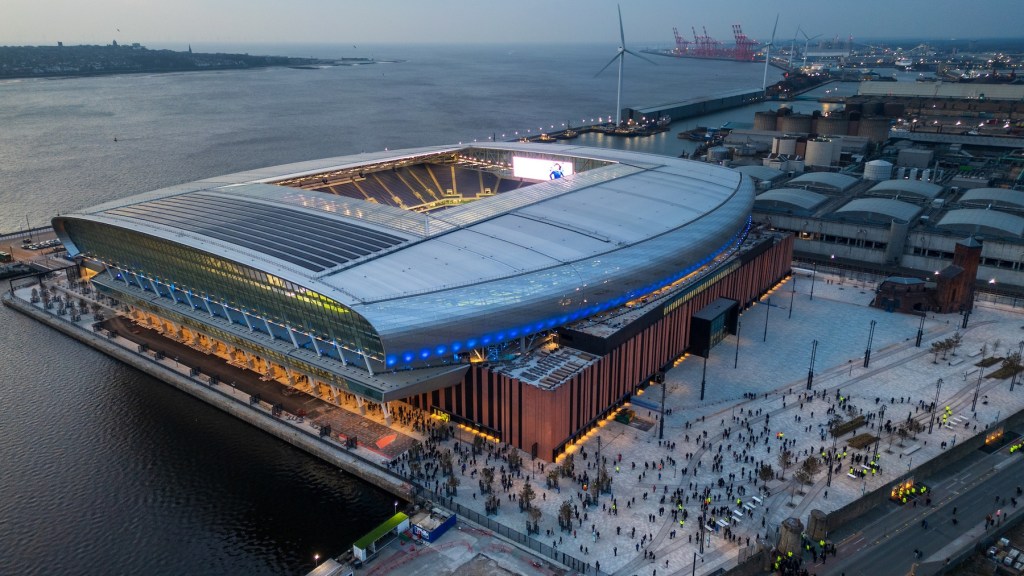
Everton Football Club and its fans have settled into their new stadium. They have moved from their historical home of Goodison Park to the new, shiny stadium on Bramley-Moore Dock.
The new stadium is fully in line with how the Premier League is commodifying football, starting with the naming of the stadium.
Selling the naming rights for stadiums is very much a modern branding style. One of the first being Huddersfield Town, who pioneered the new advertising model in 1994, calling their stadium the Alfred McAlpine Stadium, later renamed the John Smith’s Stadium. Huddersfield Town were in Division Two (now Division One) at the time, so the influx of cash from selling naming rights to help fund a new stadium was needed. A ten-year naming deal helped cover half the building cost of the new stadium.
If Huddersfield Town pioneered this, Everton FC have perfected it. Bramley-Moore stadium naming rights were sold to a commercial law firm called Hill Dickinson in what is reported to be one of the largest naming deals in English football, estimated at around £10 million a year. Not a bad piece of business for probably the largest advert in the city.
Everton’s old home of Goodison Park was a stadium that lent itself to football history. Goodison was the first purpose-built football-only stadium in England. It was deeply rooted in the old football league, decades before the Premier League, continuing the traditions of association football. Even up to modern day, Goodison ticket sales were based around season ticket purchases. A season ticket essentially being a yearly subscription to your own seat in the stadium, for as long as you continue to pay.
Goodison had a capacity of 39,572, with an estimated 31,000 season tickets sold per season. Around 78–80% of the stadium was taken up by real, mostly local fans who came to every game, come rain or shine.
Hill Dickinson Stadium is a much larger, modern stadium, with an increased capacity to 52,769 (an increase of 13,197 seats), and added amenities like bars, kiosks, cafés and a flagship shop.
The waiting list for season tickets is massive for all Premier League teams, and Everton FC is no different, with approximately 34,000 awaiting their chance. With such a large number of waiting fans, you would expect that the increase in capacity would reduce that list. Instead, they have only increased to around 32,000 season tickets. Only around 1,000 new season tickets have been made available. Add to that an increase in price from £600 to £700 a year.
Increased revenue:
Goodison – 30,500 × £600 = £18,300,000
Hill Dickinson – 32,000 × £700 = £22,400,000
Another Premier League trend that has come with the new stadium is an increase in hospitality. An estimated premium/hospitality allocation of 6,000 seats (11–12% of the stadium) is priced beyond the normal working-class fan’s ability to pay. A conservative estimate is £325 per game.
Hill Dickinson premium revenue:
6,000 × £325 = £1,950,000 per match
Over 19 games:
£1.95m × 19 = £37,050,000
Goodison Park had nowhere near that number of premium seats, with a significantly lower price of around £200 per seat.
This change is because it is the way of maximising profits. Keeping the steady stream of season tickets but not increasing it. Using the extra capacity to increase the amount of premium seats, adding corporate boxes and hospitality. Taking Everton from an inner-city club surrounded by its working-class fans to a top Premier League standard stadium, sat, lit up on the prime real estate of the famous Liverpool docks. Much more attractive to the more privileged workers.
Goodison was traditional in its monetisation of ticket sales. It was based around regular fans, limited premium seating, and relative ease of access for single-purchase tickets.
Hill Dickinson is a modern Premier League stadium based around producing the highest revenue. A two-tier stadium where single ticket sales become a scramble among the poorest section of fans, compared to the ease of transaction for high-value premium seating.
Essentially, the more you pay the more certainty you have of getting a ticket. Those who can afford to pay the premium don’t only get the best seats; they also avoid the scramble and uncertainty of the ballot system.
This isn’t an attack on Everton FC; this is happening everywhere. Everton’s neighbours Liverpool FC operate in much the same way. The advent of the Premier League was to modernise an already popular game in an attempt to maximise profits. The flashy 1990s Americanisation was finance capital recognising how much money could be made by commodifying popular sports in the United States and importing that model into Britain.
To survive in the modern league, teams have to buy into this model. To be successful, they must perfect it. Football is now a business. The gap between elite teams and those at the bottom is so large that one away cup tie can fund a smaller club for a season or more.
One of the contradictions of this exploitation of the beautiful game is the treatment of its fans. The Merseyside clubs are well known for their atmosphere. Fans come from all over to experience the history of Goodison’s Gwladys Street or the famous roar from Anfield’s Kop. The history, the stories, the noise and the love all come from fans who live and breathe these clubs. From the communities these clubs were built in. They have provided the lifeblood of these teams since their creation.
Now corporations want to bottle that atmosphere and sell it to tourists. The more they bleed from the club, the more that atmosphere is affected. Regular fans are being priced out. Season tickets were once handed down through generations; now, if you miss a few payments, the seat you held for a lifetime can be sold off at twice the price.
Everton FC is a business, like any other Premier League club. It may not feel that way to the loyal fans who spend their hard-earned money, but it certainly does to the owners who take it. The decisions are not based around the hard-core support of normal working-class fans; they are made to yield the highest profit.
The example of Everton FC is used because of the recent stadium move and the shock it has caused among fans. The problem, however, is systemic across our national sport — and it is not going away any time soon.
 Class Consciousness Project
Leave a comment