
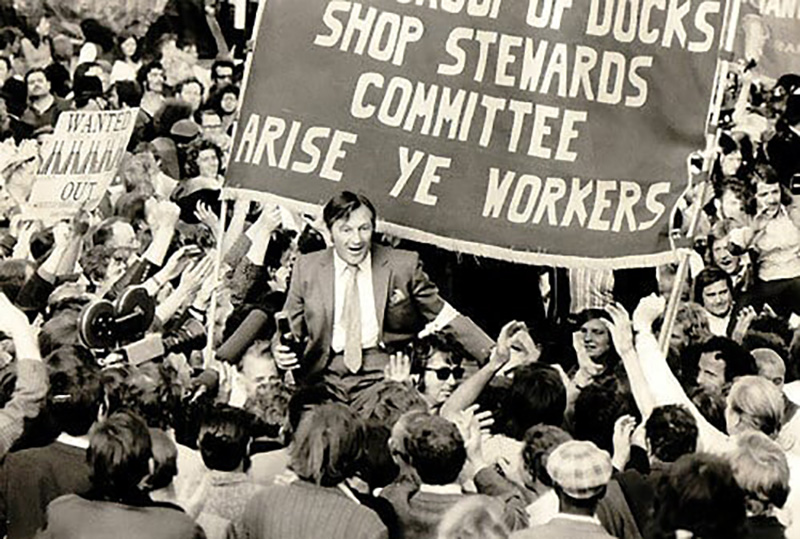
Ignorance is Blitz – why working class women must stand up and fight like Mary Bamber did.
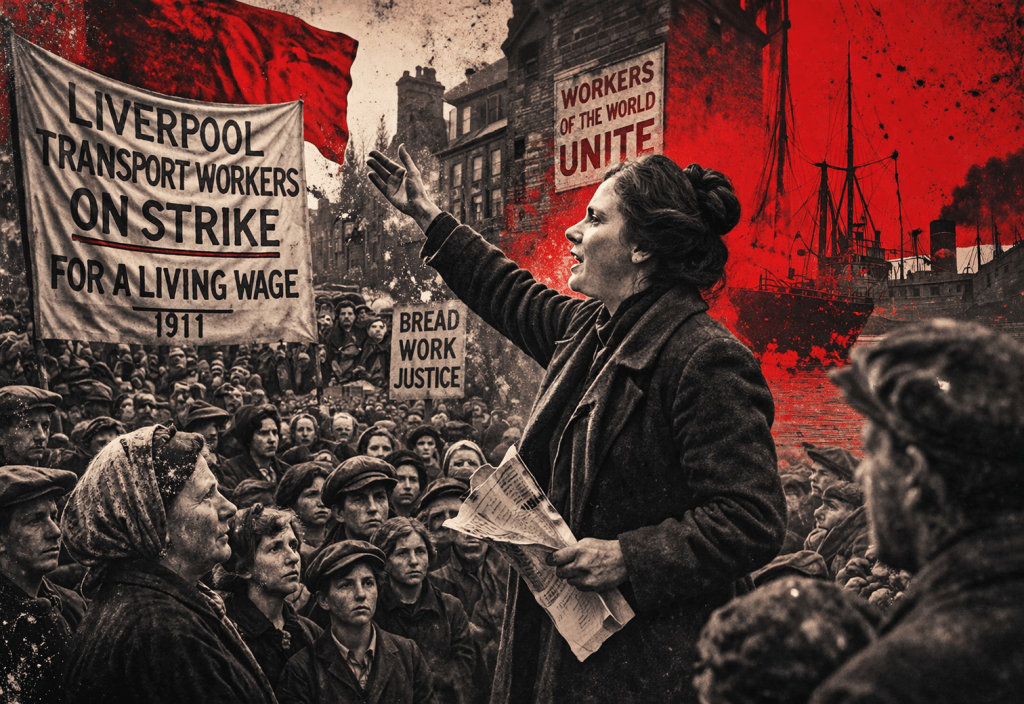
Mary Hardie Bamber — ‘Ma Bamber’ to the people of Liverpool — stands as an inspiring yet neglected figure in Britain’s working-class history. Born in Edinburgh in 1874, she devoted her life to the cause of the poor, the exploited, and especially to working women ground down by capitalist drudgery.
As a socialist, trade unionist, and community organiser, Bamber understood that poverty, unemployment, and social degradation were not isolated issues to be ‘fixed’ by charity or reform, but the direct product of an economic system built on exploitation — capitalism.
Bamber’s work in Liverpool’s slums and factories in the early 20th century brought her into daily contact with the reality of capitalist Britain. She organised women in the warehouses and ropeworks, led strikes, and fought for union representation in industries where the bosses relied on casual labour and low pay to keep workers divided and docile. She spoke at meetings on the docks, in church halls, and on street corners, her voice cutting through the hypocrisy of the ruling class and its agents in parliament. Her agitation brought her into the labour movement, and for a time, into the ranks of the communist movement — recognising that socialism was not a dream but a necessity.
Yet despite her tireless organising and her impact on working-class life in Liverpool, Mary Bamber has been largely erased from mainstream histories. This is not accidental. Bourgeois historians habitually celebrate the ‘great men’ of politics and empire while erasing the names of those who built movements from below. Working-class heroes like Bamber are written out precisely because their lives expose the lie that progress comes from the top. For working-class women the erasure is even greater, for their struggle stands at the intersection of class and gender oppression — a double threat to the capitalist order.
Mary Bamber’s story reminds us that the fight for justice cannot be reduced to a patchwork of moral causes. Today, as has always been the case under capitalism, we are confronted by endless examples of injustice — poverty wages, racism, sexism, environmental destruction, imperialist wars. But as Bamber understood, these are not separate ‘issues’ but expressions of one social system whose foundation is the exploitation of labour for private profit. To fight injustice piecemeal, without confronting its root in capitalist class relations, is to fight symptoms while the disease festers.
The other hugely important lesson is this: political mothers beget politically conscious children and in the case of Mary Bamber, the fight for working-class rights did not end with her — it continued through her daughter, Bessie Braddock.
Bessie Braddock was forged in the same conditions her mother fought against — in the poverty, insecurity and indignity of working-class Liverpool. She carried the anger and urgency of her class into political life, fighting for better housing, healthcare, and conditions for her people. She did not always arrive at revolutionary conclusions, but she never lost her grounding in working class struggle and that’s important. That grounding was not accidental — it was formed in a household where struggle was normal, where injustice was clearly labelled and identifiable, and where action followed.
And this is where the question becomes immediate, not historical.
In recent weeks, in conversations about the US/Israeli war on Iran and the general state of the world, I have encountered something deeply troubling. Female friends and colleagues — ordinary working people — openly admitting that they would rather not know. That it is all too awful and so they have switched off the news, withdrawn from engagement, and chosen to focus only on their immediate home lives. On the surface, it sounds understandable but in reality, it is a retreat. A dangerous departure from responsibility especially as many of these same people have children. They say they want the best for them but how is that to be achieved? Does the world improve by accident? Will someone else step forward to fight on their behalf? Are we simply to tread water and hope that better times re-emerge? This is not a strategy — it is passivity dressed up as pragmatism.
Ignorance is not bliss. Ignorance is exposure. It is disarmament in the face of a system that is escalating crisis and war. History shows us clearly where that leads, not to safety and stability, but to catastrophe. Ignorance is not bliss — it will mean blitz! Not metaphorically, but materially, as imperialist conflict inevitably comes home to roost.
This is why the role of working-class women is decisive. As Mao Zedong stated, women hold up half the sky. And as Vladimir Lenin made clear, without the participation of women, there can be no successful revolutionary movement, no socialism. This is not rhetoric — it is a material necessity. A working class that leaves half of itself politically disengaged is a working class that cannot win.
So this is a call that must be made plainly. Wives, mothers, working-class women — passivity is not protection and retreat is not care. To turn away from the world as it is being shaped is not to safeguard your children, but to leave their future in the hands of those who exploit and destroy. To put your children first means engaging with reality, understanding it, and acting to change it.
Mary Bamber did not look away, she organised and she fought and in doing so, she raised a daughter who continued that fight in her own way. That is the lineage that must be rebuilt — conscious, organised, and rooted in the working class. Mary Bamber’s life stands as a living example of what is required. Not charity, not reformist tinkering, not passive hope — but struggle aimed at the root of the problem. To honour her is not simply to remember her name, but to continue her work and in doing so raise politically conscious children: to do away with this rotten, stinking, fetid system and build in its place a society based on common ownership, production for need, and the liberation of humanity
 Class Consciousness Project
Leave a comment