

What are trade unions?
The British trade union movement is the biggest voluntary organisation in the country, with six million members across a variety of industries and professions, from firefighters to train drivers to musicians. Trade unions can and should be a movement for the betterment of the conditions of the working class: While their limitations are manifold and undeniable, they perform a basic good and workers everywhere are actively encouraged to join and become involved in them.
Trade unions are organisations composed of members who, by definition, must be workers. Their aims are to build working class power in the workplaces that they organise, by protecting and advancing the interests of its members at both the individual and collective levels. Amongst the things that trade unions do are:
- Negotiate with employers
- Discuss important changes with employers
- Raise members’ concerns with management
- Accompany members to grievance and disciplinary hearings
- Provide education for reps and members
- Provide financial and other ancillary services
How are trade unions structured?
Generally, trade unions are organised into branches. Branches are the ground roots of any trade union: They are where all members are organised, based on a number of factors including location, department or role within an organisation. They will (or should) meet on a regular basis.
Trade unions are governed by an annual or bi-annual conference, which is the supreme authority of that union and sets policy. Where a policy is not provided for through either the union’s rule book or at conference, the union’s Executive may set policy.
In between the branch level and the supreme authority level, there are regional and possibly sectoral divisions, depending on the size and the scope of the trade union itself.
Trade unions also will also have an Executive, elected from its membership, which oversees the strategy of the union and takes decisions on policy in circumstances where policy is not explicitly set by rule or supreme authority.
Finally, trade unions will have a General Secretary. The General Secretary is the most senior full-time official of the trade union and employing manager of the trade union’s staff. He or she will act on the instructions of the union’s Executive and may be obliged by rule to attend Executive meetings and/or the union’s Annual or Bi-annual Conference. General Secretaries are essentially the figurehead of the union and, at least in part, determine both the political and industrial direction of the union.
There have been cases where a trade union has had joint General Secretaries, but these are rare and almost always an interim arrangement following a merger between two or more trade unions.
We’ll look at each layer of trade union structures in turn.
Branches
Virtually every trade union is organised into branches. One notable exception is Nautilus International, a seafarers’ union, which has no branch structure as many of its members are at sea. The branch system of organising workers dates back to the Victorian period and trade unions have been apparently unable to develop a system which better suits the demands of workers in the 21st century. That said, branches are commonly organised around work locations, departments or roles, or a combination of two or all three of those factors. There are instances where multiple branches in the same workplace co-exist, for instance where there is one branch for workers and another for managers.
Branches are the entry level of trade unions – the democratic structures of all trade unions has branch involvement at their heart. However, some trade unions are better than others at allocating workers to the correct branch for the place that they work and the work that they do and some are better than others at telling their members which branch they have been allocated to when they join. To find out where your branch meets and when can be difficult, but you can start by talking to your work colleagues, a local trade union representative if you have one, or by calling your union’s regional or head office for information on the branch itself or the contact details of a branch officer.
Branch meetings will normally follow an agenda circulated by the branch secretary before the meeting. Agendas usually have what are called ‘standing items’, which are items for discussion which are on the agenda permanently. Topics which can be standing items include a branch finance report, a membership report and reps’ reports, but there could be other standing items. When you go to your first branch meeting, you might find it useful to listen to the discussions, perhaps take your own notes and, if there’s anything happening which you aren’t clear on, ask a branch officer or fellow member to clarify for you.
Regions
Trade unions are typically divided into regions. The regions (or districts, as they are called in some unions) can vary from one union to the next, but generally are split along the lines of London and the south east, the west, Wales, Scotland, the Midlands, the north west and the north east of England. At the regional level, affairs are managed by regional committees, which draw their memberships in a number of different ways. One method is for the branches which fall within that region or district to send a number of delegates to the regional committee based on the number of members in that branch. Other unions allow all members within the region or district to attend committee meetings, but restrict voting rights to delegates sent by branches.
Regional committees generally deal with matters affecting the entire region, including making sure that branches are operating efficiently and campaigning on issues which matter most to that particular trade union. If you want to become more involved with your region, it’s a good idea to talk to people in your branch first and get an idea of whether you can attend as a rank and file member (even if just as an observer) or if there is an opportunity to attend as a delegate.
Sectors
There are some trade unions which are known as ‘General’ unions – they don’t organise workers in any specific industry but in a whole raft of diverse industries. If your union is a general one (for instance Unite the Union), then that union will have sectors, sometimes called networks, which are similar to regions but organise their members according to the industry they work in, regardless of where in the country they work. Sectors in general unions sit alongside the regional structure, so you can become involved at a branch, regional and sectoral level simultaneously.
Sectors will deal with issues that pertain to that specific industry. They may have their own sectoral annual conference or similar periodic gatherings for people working in the same industry to come together and discuss matters affecting their industry.
Remember that unions organised around one industry won’t have formal sectors, but may have more informal networks and self-organised groups based on a specific function within an industry or based around protected characteristics.
Supreme Authority and Executive Committee
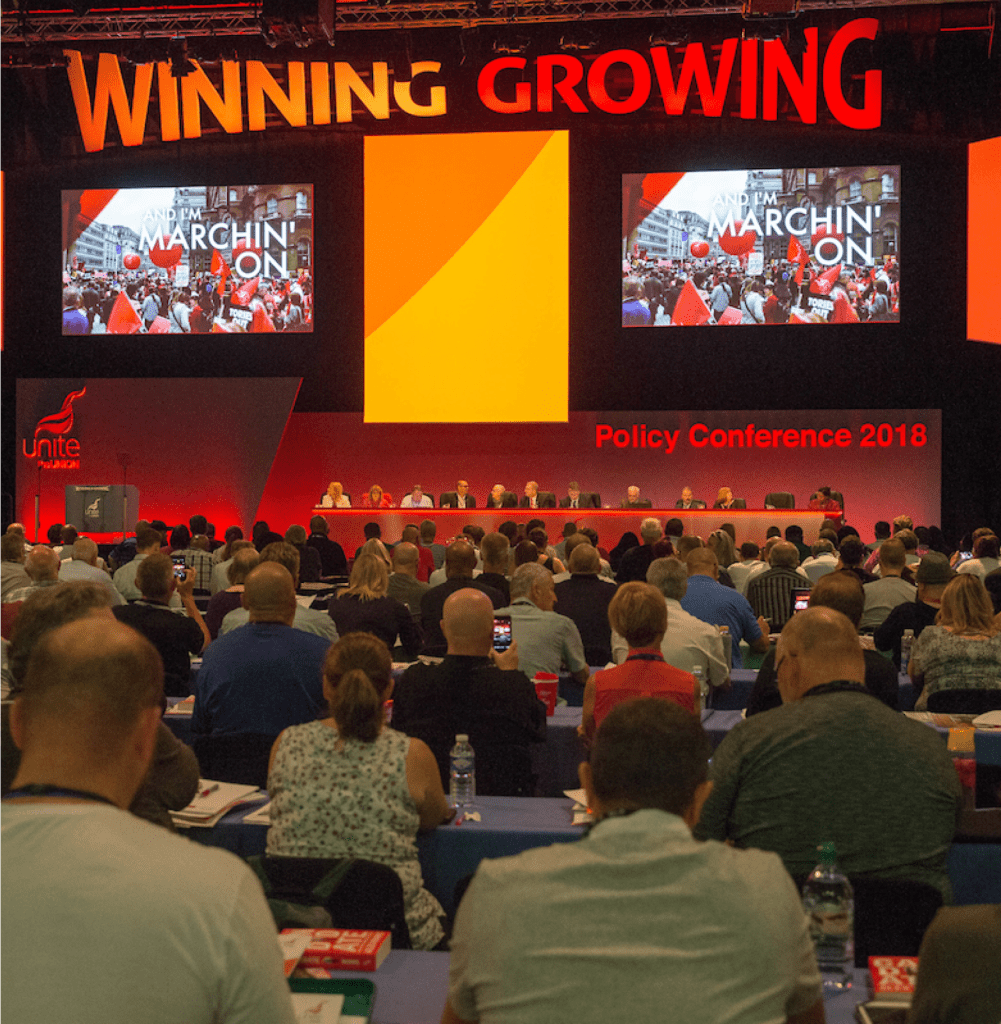
Trade union policy is set by a combination of the Supreme Authority and the Executive. The Supreme Authority can take the form of an Annual Conference, Annual General Meeting (the difference is in name only) or a Bi-Annual Conference in the case of larger unions. Branches can submit motions to these conferences either directly or via the regional level, depending on the trade union, and those motions are then debated and voted upon. If the motion is carried, then that motion becomes union policy and the Executive and every level below in the union is duty-bound to adhere to it.
The Executive manages the affairs of the union between conferences. Their duties are to:
- Oversee the management of the affairs of the union
- Protect the integrity of the union Rule Book and the policies of the union
- Oversee the strategic direction of the union
- Make policy where not provided for in the Rule Book or Conference
- Instruct the General Secretary on issues including balloting and taking industrial action
This list isn’t exhaustive and Executive duties vary from union to union. Some unions have Executives who meet periodically, while others have a permanently-sitting Executive who will meet as and when the need arises and are released from their ‘day job’ for the duration of their term.
Part two can be found here…
 Class Consciousness Project