

Anti-trade union legislation
Trade unions have suffered at the hands of decades of anti-trade union legislation – acts of Parliament passed over the course of some forty years to restrict the rights of trade unions and their members. Most of these acts have been introduced by Conservative Governments, but none of them have been repealed by a Labour Government.
What was the net result of these anti-trade union laws?
- A limit, then a ban on the ‘closed shop’, which obliged workers to join a trade union
- Employers became legally entitled to take out injunctions on trade unions to prevent strike action
- Political strikes were made illegal
- ‘Secondary’ or ‘Solidarity’ strike action was made illegal
- Secret ballots for industrial action were imposed
- Trade unions are required by law to either repudiate or call a ballot in response to unofficial strike action by trade union members
- Voting thresholds imposed on ballots in industries considered ‘essential’
- Strict controls on organising strikes, including picket lines
- A legal ‘opt in’ assumption on trade union political funds
Even taking these pernicious acts of legislation into account, why do so many workers feel unable or unwilling to engage with their trade union beyond paying their subscription fee? There are many reasons, but some key ones are:
- They don’t know how to get involved
- Trade union structures are complicated, inflexible and favour experienced members over novices
- There is a vested interest amongst some members to keep engagement to a minimum
Why should I get more involved?
Trade unions have developed what is called the ‘servicing model’ over the last forty years. The servicing model treats its members like customers – think of the union as you would a service like the Automobile Association or insurance on a high-tech item at home: You pay for the option to use the service, but cross your fingers and hope that it doesn’t come to that, but beyond that you don’t get involved in the way that the AA runs its business or how the insurance company insures its customers.
Unfortunately trade unions have spent decades encouraging members to join them as an insurance policy and little else, but trade unions are much more than simply insurance for workers. They are political entities who organise between them about 20% of the entire British workforce. While that percentage could and certainly should be higher, it gives the trade union movement as a whole considerable industrial and political power, which all members should be able access and exercise.
Your union may well be one of the better ones, but without constant pressure from members on its Executive and General Secretary, the force for positive change within any trade union will dissipate and die off completely. Internal democracy atrophies and a caste of well-paid and largely unaccountable trade union bureaucrats will develop, strangling the trade union and acting against the best interests of the members whose subscriptions pay their wages.
It’s therefore vital that workers not only build this pressure on their Executives and General Secretaries, but also create a ‘churn’ of people within a trade union, where rank-and-file members ascend to the highest levels of the union, serve their terms of office and then return to their workplaces with the skills, knowledge and experience of working at that level that they can share with their colleagues, in the hope that they too will ascend to the highest levels of the union themselves.
How can I get more involved?
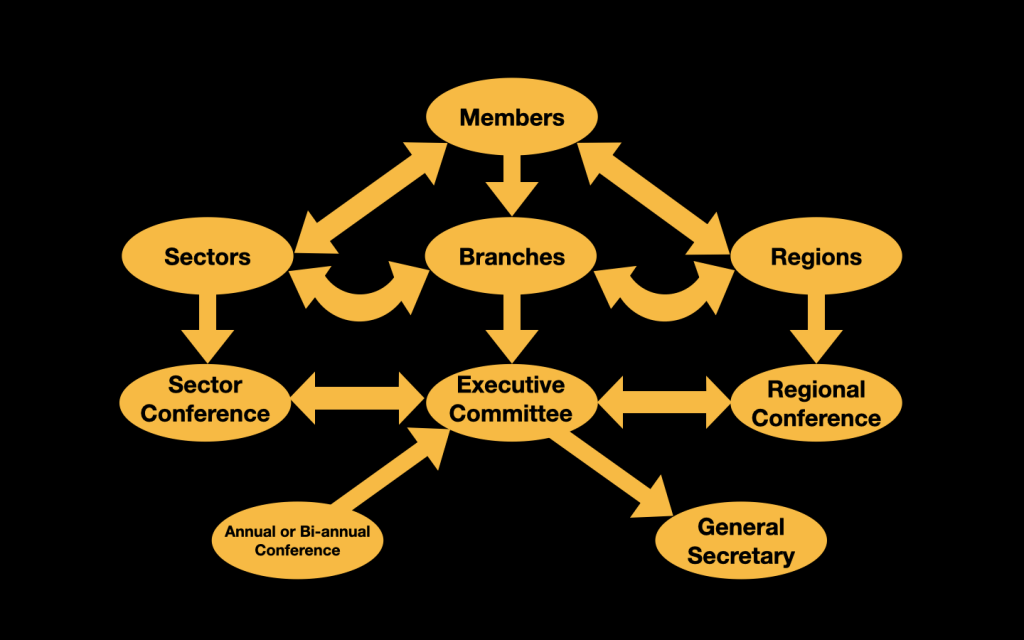
It all starts at the branch level! For members in some trade unions, the hardest task is to find out where and when their branch meets – members are often not given these details when they join and branches themselves often don’t contact their members to inform them that a meeting is coming up, for a variety of reasons. As we said in part one, the best place to start if you’re looking for your branch is to look in your workplace: Check trade union noticeboards if there are any, talk to your colleagues, track down your rep if you can and, if all else fails, call your trade union’s regional or head office for help.
Get along to your branch – actually attending meetings will help you develop an understanding of how branches work and give you some insight into the structures of the union outside of the branch, including regional and sectoral levels. It will also give you an opportunity to build relationships with other people, including those who may be employed outside of your workplace.
 Class Consciousness Project