
In this guide, we will show you how to write motions for your local branch, annual general meeting or anywhere in between within your trade union structure.
What is a motion?
The dictionary definition of a motion is “a formal proposal put to a legislature or committee”.
The best way to explain how motions work is to imagine your branch meeting, or wherever else you are raising your motion, as an entity that has its own decision making power. A motion is the process through which that entity sets its policies: A motion, once carried, is such a policy.
How is a motion carried?
A motion is carried after a debate at a formally convened meeting, but there are a couple of steps you will need to go through before we get to the debating stage. The first step is obvious but is worth stating – draft your motion! Later in this guide we’ll show you how best to format your motion, giving you some tips to bear in mind when writing them.
The next step is to get your motion placed on the agenda of whatever meeting you will be debating it. An agenda is the formal order in which the business of the meeting is taken. Unions vary in terms of how motions are placed on the agenda, but commonly at branch level, which is the entry level in trade union democracy, the agenda is drafted by the Branch Secretary (sometimes called the Correspondence Secretary), often in liaison with the Branch Chair. Branches have local rules on how agendas are compiled and circulated before meetings, but aim to have your finished motion submitted to the Secretary at least ten days before the date of the next meeting in order that it can be placed on the agenda in good time.
In the case of a regional or national conference, you’ll need to talk to your branch secretary and/or consult your union’s rule book to find out how a motion is submitted. Commonly the motion would have to be first passed at branch level, but beyond that stage unions differ on how motions are submitted – they could be submitted by branches or via regions.
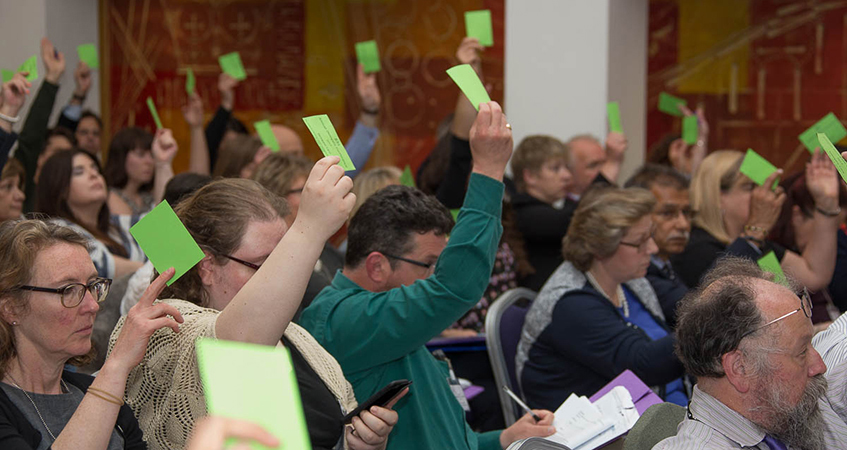
When the motion is on the agenda, it will be debated once it becomes the next order of business. The mover of the motion (that’s you!) will be allowed to speak to the motion – speaking to a motion can be a short explanation of the aims of the motion or, at more formal gatherings like annual conferences, will take the form of a speech, which is timed. The Chair may then allow speakers from the floor to contribute, or call specifically for a speaker who is opposed to the terms of the motion, if there are any. However the Chair decides to allow the debate to take place, remember that, as the mover of the motion, you have the right to speak in reply to any other speaker(s) in the debate and that your reply closes the debate. Once the debate is closed, the Chair will move to a vote – usually a simple majority is required in favour of your motion in order for it to be carried.
During the motion, an amendment may be proposed. An amendment needs to be debated and carried similarly to a motion and, if carried, will alter the text of your motion to that contained in the amendment. An alteration can take the form of removing text, adding text, altering existing text or a combination of all of these. There are rules on amendments, the most important of which is that an amendment cannot defeat a motion, so the Chair will need to be alert to the potential effect of a motion should that amendment be carried. If the Chair believes that the amendment is intended to defeat the motion, they may rule it out of order – it will not be debated and is struck from the record.
Any amendment is debated once the motion has been moved. The mover of the amendment will speak to their amendment, with the mover of the motion having the right of reply. Once this has been completed, there will be vote, again usually with a simple majority in favour of the amendment required for it to be carried. If the amendment is carried, then the owner of the motion transfers from the original mover (you) to the person who moved the amendment. The new owner then has two options: To continue the debate as the new owner of the motion, or to hand the motion back to the original mover. This process applies if there is more than one amendment proposed to a motion.
As the mover of the motion, where amendments are submitted formally prior to the meeting or conference, you have the option to either reject accept the amendment. If you reject the amendment, then it will be debated on the floor of the meeting or conference alongside the motion, if you accept the amendment then this will mean that there will be no debate on the amendment and your motion will be amended accordingly.
How do I write a motion?
Motions can seem quite daunting to anyone writing them for the first time, but if you follow this simple format, it will become a lot more straightforward. A motion should be set out as follows:
- Note
- Believe
- Resolve
We’ll now explain what each component part of your motion means.
Note: In this part of the motion, you should set out clearly what the situation is that your motion is taking a position on. It could be a contemporary issue, a work-related problem, a union policy or indeed anything else – it’s in this part of the motion that you set the scene and explain to the reader exactly what it happening and, if appropriate, why it’s happening.
An example of a note section of a motion could be:
“We note with great concern the continuing cost of living crisis, continuing high rates of inflation and steadily increasing interest rates”, or
“We note that the situation regarding the future of the pension fund and whether or not it will remain a final salary pension scheme is yet to be resolved, despite assurances that members would be given clarity”
Believe: In this part of the motion, you should set out clearly what the position of the motion is to the situation you set out in the ‘note’ section: Does the motion agree with the situation? Does it disagree? If so, why? The ‘believe’ section is essentially the bridge between setting out what the situation is and the ‘resolve’ section, which sets out what is to be done.
Examples of a believe section of a motion could be:
“We believe that working class people should not yet again become the victims of the ruling class’s incompetence and ignorance of the fiscal crisis that they have created. They continue to peddle the myth that workers are the drivers of inflation as they demand wage rises to keep up with the rising cost of living – we must disabuse them and the wider public of this false notion.”, or
“We believe that pensions are deferred wages: Our members entered into a covenant with the employer that at the time they retire they would be afforded a decent living pension. That covenant must be upheld by the employer and any attempt on their part to renege on their agreement must be resisted, if required with strike action.”
Resolve: This is the most important part of the motion – it’s here where you set out, having explained the situation and what you think of it, what you believe should be done about it. This is where many people writing motions for the first time or who don’t have a great deal of experience in writing motions often trip up. Either they don’t make any resolutions (which creates a motion which just looks like a statement) or their resolutions lack clarity or are open to interpretation. It’s vital that any resolutions you state are as clear and as unambiguous as possible.
Examples of a resolve section could be:
“We resolve to:
- Immediately begin a campaign of action, including but not limited to strike action and action short of strike, to defend members against attacks both from the cost of living crisis and employers,
- Make immediate contact with the Executives of other trade unions to commence talks aimed at co-ordinating similar action across the industry and beyond, and
- Convey the terms of this motion to the Trades Union Congress and the Government”, or
“We resolve to:
- Instruct the Executive to take necessary steps for a ballot, for strike action and action short of strike, of all members affected by any changes to the pension fund,
- To contact the CEO of the employer to make clear that workers will not tolerate any attempt on the part of the company to erode our hard-won terms and conditions, including our pension, and
- To immediately commence a media campaign to highlight the actions of the employer”
It should be noted that the use of the word ‘we’ should be substituted with terms such as ‘This branch’ or ‘Conference’ or whatever term fits best with the level of the democratic structure your motion will be debated at.
You’ll see in the resolutions above that we have used bullet points to emphasise the actions required. Any motion that you compose doesn’t have to use bullet points, but you may find that they add clarity, particularly when setting out a detailed or complicated subject – you may also find the use of bullet points useful in the note and believe sections of your motion.
Taking the strands of note, believe, resolve and bringing them together, we have created these two motions:
“We note with great concern the continuing cost of living crisis, continuing high rates of inflation and steadily increasing interest rates.
We believe that working class people should not yet again become the victims of the ruling class’s incompetence and ignorance of the fiscal crisis that they have created. They continue to peddle the myth that workers are the drivers of inflation as they demand wage rises to keep up with the rising cost of living – we must disabuse them and the wider public of this false notion.
We resolve to:
- Immediately begin a campaign of action, including but not limited to strike action and action short of strike, to defend members against attacks both from the cost of living crisis and employers,
- Make immediate contact with the Executives of other trade unions to commence talks aimed at co-ordinating similar action across the industry and beyond, and
- Convey the terms of this motion to the Trades Union Congress and the Government”
And:
“We note that the situation regarding the future of the pension fund and whether or not it will remain a final salary pension scheme is yet to be resolved, despite assurances that members would be given clarity.
We believe that pensions are deferred wages: Our members entered into a covenant with the employer that at the time they retire they would be afforded a decent living pension. That covenant must be upheld by the employer and any attempt on their part to renege on their agreement must be resisted, if required with strike action.
We resolve to:
- Instruct the Executive to take necessary steps for a ballot, for strike action and action short of strike, of all members affected by any changes to the pension fund,
- To contact the CEO of the employer to make clear that workers will not tolerate any attempt on the part of the company to erode our hard-won terms and conditions, including our pension, and
- To immediately commence a media campaign to highlight the actions of the employer”
A few tips:
Don’t be tempted to write your motion like a speech – writing paragraph after paragraph to layer details onto a motion may seem like a good idea, but by keeping your motion as to the point and concise as possible, you’ll find readers of the motion will be more likely to engage with it and you can use the details you omit as part of any speech (or speeches) you will make on the motion.
Be as clear as you can in setting out the situation, what you believe and, crucially, what you resolve to do about the situation – the key distinction between good motions and not so good motions is the clarity and purpose of its resolutions. Don’t give your branch, conference or anywhere else that your motion is being debated the opportunity to interpret your resolutions in a way that you didn’t intend!
Don’t be afraid to share your motion with people that you can trust for their input. Trade union activism favours the experienced, so lean on people with that experience for help.
If you need any help or advice in writing your own motions, email us at classconsciousnessproject@gmail.com and we’ll do our best to assist you.
 Class Consciousness Project