
(Photo: GETTY IMAGES)
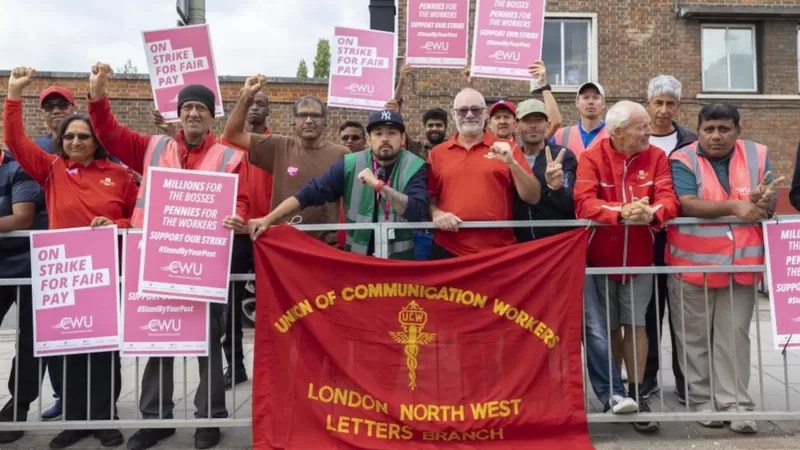
The Communications Workers Union announced on Tuesday 11th July that its members had voted, with a majority of over 75%, to accept the ‘offer’ made to them by Royal Mail, and so ending a dispute that will serve as a lesson to every trade union activist in the movement on both the inherent limitations of trade unions and, most importantly, the huge potential for failure in trade unions led by bureaucrats who act without real and active member-led accountability.
The result revealed that 67% of members had returned their ballot papers, of which over 75% had voted to accept the dreadful offer made by Royal Mail, which the CWU’s bureaucracy had recommended for acceptance. A 12-minute live YouTube video, hosted by CWU General Secretary Dave Ward, certainly did not appear to the casual observer as a victory parade: Ward proclaimed the vote as an ‘overwhelming’ endorsement of the below-inflation pay deal that they had accepted, then went on to speak of wanting to bring the union back together, clearly cognisant of the deep splits in the union that the actions of the trade union bureaucracy, and Dave Ward in particular, had created.
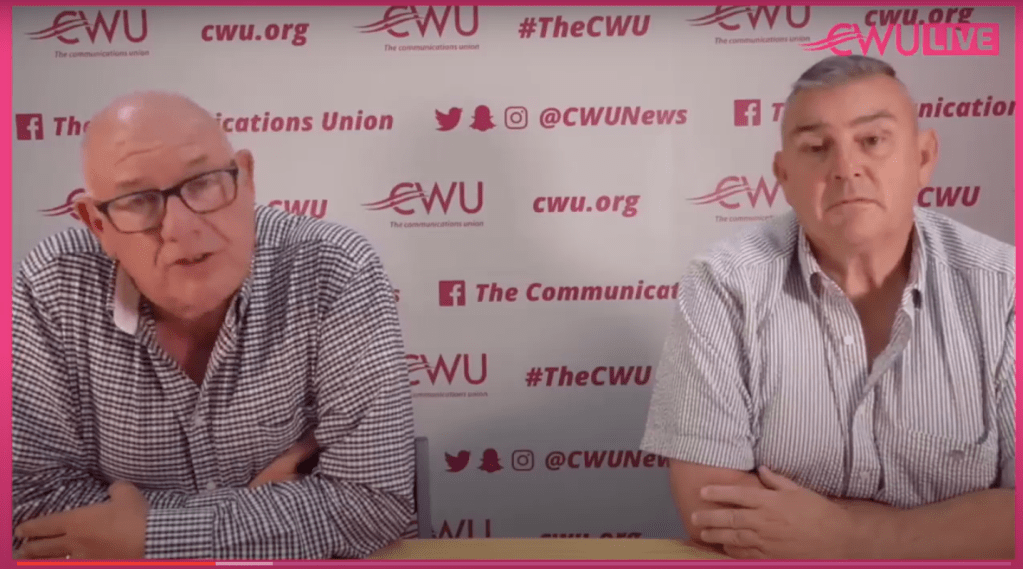
Perhaps Ward, sat alongside deputy General Secretary Andy Furey, had one eye on the live chat during their broadcast, where some of the 24,000 watching members expressed their anger with a combination of clown emojis and calls for Ward’s resignation. Many stated in the chat that they would be leaving the union entirely. Ward pleaded with members watching to ‘stay and fight’, apparently overlooking that this is exactly what members were doing for months in 2022, only to be betrayed by their union leaders in 2023.
The deal that the CWU recommended to its members was:
- A three year pay deal totalling 10% across the whole three years, plus a one-off payment of £500
- A guarantee of no compulsory redundancies before April 2025
- An ‘independent review’ of conduct cases arising from the dispute
- The inclusion of Engineering staff in the deal
Barely any detail of this rotten agreement is beyond criticism: From the outset, the union itself claimed a pay rise that at least matched inflation, yet they buckled and accepted a pay offer that barely exceeds inflation in its totality, but is for three years duration – an average pay rise of just 3.3% per year, with the current Retail Prices Index figure of 8.7%. 2% of that 10% pay rise had already been imposed on workers by Royal Mail, leaving CWU with the credit for an 8% pay deal over three years.
The negotiators also were only able to stave off compulsory redundancies until 2025, but will still allow Royal Mail to offer voluntary redundancy, while CWU’s own members who have found themselves sacked or under investigation by Royal Mail’s management for alleged transgressions during strike action will be subject to an ‘independent review’ chaired by a former Lord Chancellor.
So the dispute appears to be at an end and appears to be a total defeat for the CWU, much like the total defeat for the Royal College of Nursing that we examined in early July. CWU members took part in strike action for months during 2022, voted overwhelmingly in favour of renewing their strike mandate, as required by anti-trade union laws, only to see their trade union bureaucracy fail to call a single day of strike action in 2023 before selling them a deal unworthy of the name.
CWU had already done this in BT: In December 2022, they collapsed into accepting a below-inflation pay rise for their members, having called their members out on strikes for the first time since 1987, claiming that the final and accepted offer was “the maximum that can be achieved by negotiation leveraged by your industrial action”.
The similarities between the CWU’s collapse in Royal Mail and the RCN’s in the NHS are stark. Strong rank and file support for strike action to win fair pay claims and to defend hard-won terms and conditions has been wiped out by trade union bureaucrats who reached a critical point in their disputes, where the employer was not prepared to make any further concessions and, instead of escalating strike action, the unions capitulated, returning to their members with recommendations to accept rotten deals based on the assumption that no further progress could be made.
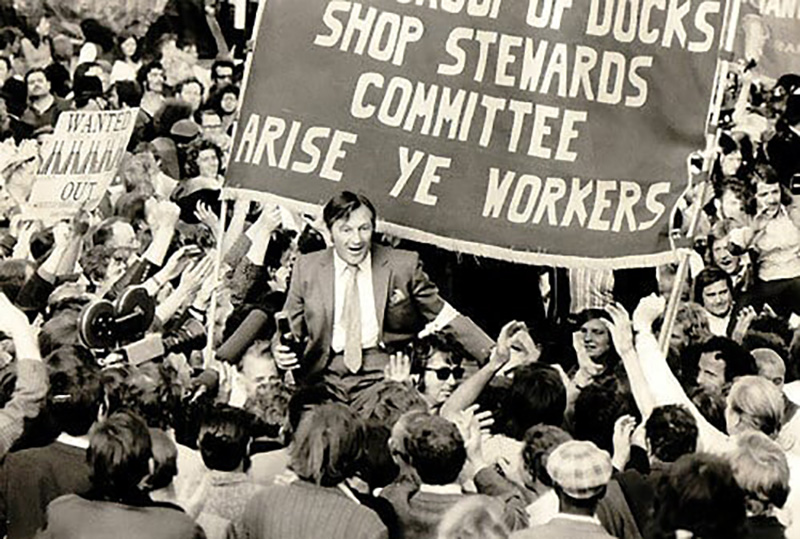
The CWU leadership realised that they were faced with two options: To escalate the strike action even further in support of their members’ claim, or to end negotiations and accept the ‘final’ offer made by Royal Mail and face the ire of the membership, so they opted for the latter and, in doing so, they worked to defuse the anger and kill the momentum that had been built up through months of successful industrial action by going on a roadshow across the length and breadth of the country to sell the terrible deal that they had negotiated to members in April, as well as to take the conscious step to end strike action and not call their members out for a single day in 2023. Trade union bureaucracies have perfected the art of killing momentum in disputes where they risk losing control of their members, going all the way back to the sacking of the AUEW’s Derek Robinson in 1979, when the union organised a postal ballot for strike action to support Derek, which failed, when ballots were usually conducted by a show of hands in the car park. This decision clearly showed that the AUEW had abandoned Derek and had left him to his fate.
The explanation as to why trade union bureaucracies capitulate in such a wretched and cowardly fashion lies in a conflation of factors, of which we will examine two.
Firstly, trade union democracy is fetid and rotten and has been for decades. Arguably the high point for member-led democratic activity in the trade union movement was in the early 1950s, yet bureaucrats have been scratching their heads ever since, trying and failing to think of ways to restore democracy – indeed, we would argue that they have a vested interest in keeping the democratic structures of trade unions as rotten and as non-functioning as possible, as Unite’s absurd decision to remain affiliated to the imperialist Labour Party has demonstrated.
A lack of tangible democracy in the trade union movement means that the schism between members and the bureaucrats which act in their name is as big as it has ever been and members find themselves, often out of desperation, resorting to leaving their union in protest when ‘deals’ like the CWU has struck in Royal Mail and BT lead them to believe that not only is their union useless, but that they can’t do anything about it whilst remaining a member.
This deficit of democracy also means that, for well-remunerated trade union bureaucrats, there are no consequences for their actions – Dave Ward will arguably remain as General Secretary of the CWU for as long as he wants the position, knowing as he does that elections for General Secretaries have notoriously poor turnouts (15% of the union’s membership is considered a good turnout) and trade union bureaucracies are extremely adept at grooming future full-time officials from a tiny pool of activists who meet their criteria for political and industrial beliefs.
It should be said that this deficit in democracy is not in itself because of the trade union movement’s democratic structures themselves – they have remained largely unchanged for decades and were the same structures which were so vibrant in the early 1950s. What has, at least in part, led to the atrophy of democracy in trade unions has been the abandonment of any class-conscious education of members at all levels. Trade unions would run ‘weekend schools’, where members would be educated in class and class-based politics in seaside or countryside locations, which gave them the opportunity to learn, to make new friends in the movement and to socialise in a comradely setting with people like themselves.
But the trade unions abandoned these schools many years ago as part of their transformation, which began in the late 1980s, from the ‘organising’ model, which engaged with members at every level and gave them the education and support to be workplace leaders, to the ‘servicing’ model, where the union took members’ money, gave them a local representative (maybe) and a raft of offers, including cheap insurance and will writing services.
Secondly, the trade union movement’s links to the Labour Party is a key factor in the trade union movement’s inability and unwillingness to gain real wins for their members in industrial disputes. The Labour Party and trade union movement are run at their highest levels by people who are essentially the same – university educated, often petty bourgeois or at least upper working class and these people move effortlessly between these two bureaucratic layers because their politics allows them to do so. They are essentially liberals or social democrats who believe that working class people can only win concessions from capitalism and, critically, see employment in the Labour Party as a good way to gain a leg-up into a well paid trade union role, but also that a well paid role in a Labour-affiliated trade union is a good way to gain a leg-up as a Prospective Parliamentary Candidate for the Labour Party, or maybe a paid Labour Party full-time staffer.
This means that militant trade unionism is spurned by the Labour Party and the bulk of the trade union movement. Where trade union leaders find themselves stuck between the militant elements of their own membership and the employers, they will collapse in favour of employers every single time.
CWU members will, quite understandably, be extremely angry at the actions of their trade union and many will be considering their future membership or may have even left the CWU already. Remaining in the CWU at this difficult time may seem futile and certainly does not constitute an endorsement of the union bureaucracy or its actions in capitulating in this dispute, but is a necessary step to transforming this trade union into a democratically accountable movement, fully connected to its members and militant enough to make the difficult decisions and take the tough action required to win real and lasting improvements to workers’ pay and conditions.
Until trade union members are given the means and the opportunity to develop a class-based knowledge, to become leaders in their own workplaces and place real pressure on their trade union leaders to stand and fight or be replaced, then the collapse of the Royal Mail strike will be just another in a long list of trade union failures.
Our Resources section contains the following guides for trade union members and activists:
An Introduction to trade unions – part one
An introduction to trade unions – part two


 Class Consciousness Project
Leave a reply to Peter Cancel reply