
Everton and Wales. If you know your history.…
A common joke among football fans, particularly Reds like myself, is to laughingly refer to Everton fans as Welsh. Many perceive this as light-hearted banter about fans not hailing from the local area. However, there’s a kernel of truth to it, albeit not in the manner one might expect.
Everton FC traces its origins back to 1878, initially known as St. Domingo’s FC, named after a small Methodist church situated on Breckfield Road North in the village of Everton. The team emerged to provide a sporting outlet for the church congregation throughout the year, unlike cricket, which was predominantly a summer pursuit. Within a year, the team adopted the name Everton Football Club. They subsequently became one of the founding members of the football league and have since remained one of the longest-standing top-flight clubs.

Until 1895, Everton village and Walton stood as separate entities from Liverpool, being part of Lancashire instead. However, as Liverpool expanded, its boundaries pushed beyond the boundary road, encompassing the end of Walton and the beginning of Bootle. Everton itself was a quaint rural village nestled amidst farmlands, offering picturesque charm in its own right.

The town provided a scenic backdrop, with views overlooking the bustling dock city of Liverpool and upward towards Walton-on-the-Hill, where it relocated to in 1891 following a dispute between the club and future Liverpool Lord Mayor John Houlding.
The dispute was very convoluted, involving various elements such as a loan from Houlding to the club and a minority landowner’s stake in Anfield, culminating in an attempt to raise the ground’s rent by £100.
An interesting historical footnote: Everton holds the distinction of being the first professional club to implement goal nets during their tenure at Anfield.
After the fallout over Anfield, Everton effectively relocated up the road to Mere Green in Walton, an even more rural area inhabited by a robust working class deeply involved in the ‘home trades’ of slate, timber, and stone. These trades, closely intertwined with Wales, drew many Welsh workers to the area, to the extent that Walton was once dubbed the second capital of Wales. The name ‘Walton’ itself may derive from the Saxon word ‘Waeles’, meaning ‘foreigner’, or from the Old English ‘Wald Tun’, signifying ‘Forest Town’.
Even today, remnants of Welsh influence linger in Walton. Pubs still bear Welsh names like The Harlech or The Chepstow. Road names such as Anglesea or Caernarvon (both spelled incorrectly; Caernarfon in Wales has an ‘F’, though with a different pronunciation from the English ‘F’) reflect this Welsh connection. Interestingly, the streets in the county ward between Goodison Road and County Road were originally named after Welsh builders Owen Elias and his son William Owen Elias, their initials forming the basis for street names. The names now broken up by the demolition of some of the streets.
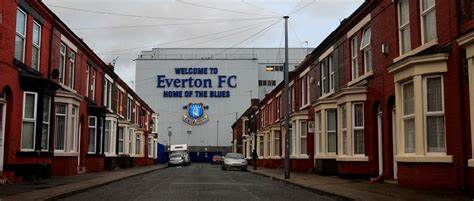
Understanding the history of the area, one can envision Mere Green (Goodison Park) as a hub of working-class Welsh immigrants, passionately supporting their local team. Picture them after a hard day’s work, loading slate or timber onto the Walton trains, gathering at The Harlech for a pint before heading down Spellow lane to the match. Many returned to Wales once their work was done, or enough money was earned, but they carried with them a deep affection for their adopted football club, giving rise to the Welsh Evertonian.
The growth of the football league and the advent of the modern Premier League have forever changed the dynamics of clubs like Everton. Whether for better or worse, these clubs now possess fan bases that travel from near and far. Many clubs even cater to traveling fans, capitalizing on the money they spend. You’ll find that some of the biggest clubs’ stadiums offer every amenity a traveling fan could desire but forced into paying premium prices to have the club’s logo on your napkin.
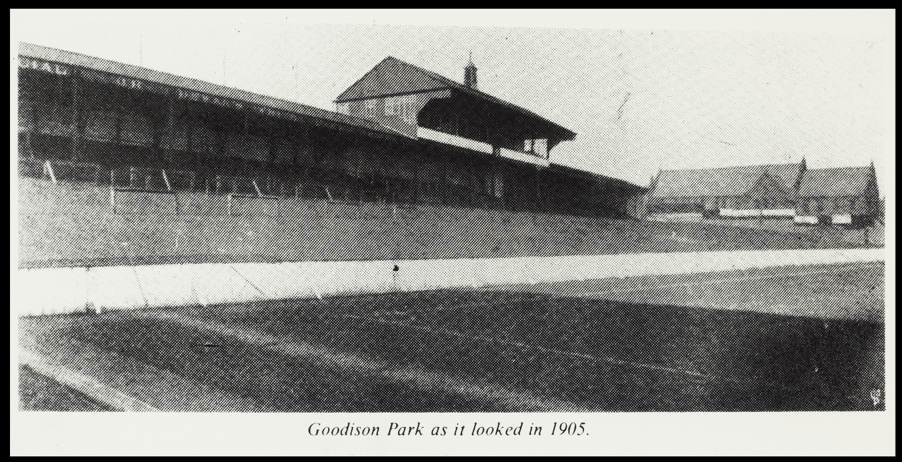
For the time being, Everton resides at its long-time home, Goodison Park, nestled right in the heart of the still very working-class community of Walton. I can confidently say that the area hasn’t changed much since Welsh builders Elias & Sons Builders erected the rows of terrace houses, that fill county ward, in the early 1900s. The history of the area is deeply intertwined with the club, to the extent of having Prince Rupert’s Tower, the Everton Lock-Up, as part of its crest. The lock-up taking its name from when Prince Rupert brought his royalist army to reclaim Liverpool Castle from the Roundheads in 1644.

The 2024-25 season will mark Everton’s final season in Walton. They will be relocating to Liverpool proper, to their new stadium on Bramley Moore Dock, and I can’t help but feel a sense of sadness about that. As I mentioned at the start of this article, I am not an Evertonian; I actually support their rivals, Liverpool FC. However, I am also a resident of the local area and have a deep appreciation for its history.
Everton was founded before the city of Liverpool expanded outward, born in Lancashire and steeped in the traditions of rural townships. While the club has obviously evolved with the times and adapted to changes in football, its departure from this area will bring about significant changes for both the club and the community.
When Everton FC finally make their next move to Bramley Moore and the tourists come, what will happen to the working-class Walton Welsh Evertonian?


 Class Consciousness Project
Leave a reply to Gari Wyn Cancel reply