
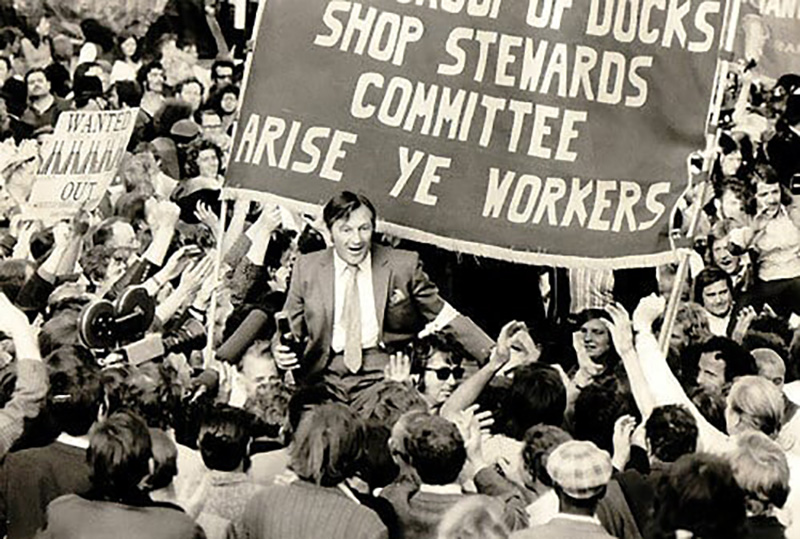
“ A class cannot exist in society without in some degree manifesting a consciousness of itself as a group with common problems, interests and prospects”

– Harry Braverman

Adolescence

Netflix’s Latest Liberal Mind Rot

The new British Netflix programme that everyone’s talking about, Adolescence, has even won the public endorsement of Labour Party Prime Minister Keir Starmer. He was apparently so moved by the show that he posted about it twice on X (formerly known as Twitter). In one of those posts, he claimed the programme “hit home” for him as a father of two, and backed plans for Netflix to show the series “free” in schools. In the other, he praised conversations he’d had with charities about the issues raised.

The show centres on a young boy called Jamie and his family. It opens with a dramatic police raid on the Miller household, dragging 13-year-old Jamie off to a police station. There, during a recorded interview, police show Jamie and his father CCTV footage of Jamie stabbing a young girl multiple times, resulting in her death. The brutality of the crime jars against the image of a frightened, seemingly normal child and a supposedly stable family. This contrast is clearly engineered for dramatic effect: the boy next door who turns into a killer.

The next episode follows two detectives investigating the crime. Most of this plays out at Jamie’s school, where it’s revealed that the environment is rife with cyberbullying. Jamie, we’re told, was one of its victims. The writers then take a bizarre turn, dragging in the term “incel” (involuntary celibate) as if this is a word being thrown around the playground. Frankly, I found this absurd. To describe 13-year-old boys as incels is not only creepy, it’s completely detached from reality. I remember school well enough to know teenage sexuality exists, but there was never any expectation for boys of that age to have “lost their virginity”. Even official statistics reflect that—just 19% of teenagers report having sex before the legal age of 16.

So, what’s the real focus here? Ostensibly, it’s cyberbullying. But the introduction of incel rhetoric is a clear set-up for what’s coming in episode three.

Seven months have passed, and Jamie is now held in a youth detention centre. We watch him undergo a psychological assessment with a cold, middle-class female psychologist. By this point, Jamie appears to have completely changed character. Either he’s undergone a massive personality shift or, more likely, the writers want us to believe he was harbouring the mindset of a misogynistic adult all along. Gone is the frightened boy. In his place, a miniature bigot.

The agenda becomes blatantly obvious in this episode: the demonisation of so-called “toxic masculinity.” This had already been hinted at with the incel playground nonsense, but now it’s front and centre. As per usual with liberal media, class, poverty, or systemic abandonment are completely ignored.

Jamie’s family live in a tidy house, and while there’s a nod to the struggles of working life, the show never once mentions the non-stop attack on working class communities for over 50 years leading to multiple generations growing up hopelessly alienated. Jamie isn’t shown as a product of economic collapse or social fragmentation, he’s just a “damaged” boy poisoned by masculinity. His community isn’t crushed by capitalism, it’s merely “troubled” by culture. His actions aren’t politicised—they’re pathologised.

This is the standard liberal manoeuvre: strip class from the equation and you can repackage social crisis as a morality tale. The contradictions of capitalism become individual pathologies. The working-class boy is no longer a product of political economy, he’s reduced to a clinical subject, to be examined, corrected, and ultimately contained. His suffering is depoliticised, his fate preordained, not by class struggle, but by institutional management.

The final episode returns to Jamie’s family. It’s his father’s birthday, and they’re trying to return to some kind of normality. That attempt is ruined by a group of teenagers defacing his work van. En route to clean it up, they receive a call from Jamie saying he’s decided to plead guilty. The parents return home, trying to come to terms with his decision. Once again, the cause is pinned on this phantom called “toxic masculinity” and the online radicalisation of children into misogyny.

In all honesty, I find this miniseries deeply dishonest. Stephen Graham, who plays Jamie’s father, has starred in some genuinely strong films; Gangs of New York, Snatch, This is England. But more recently, his roles have become increasingly politicised in the worst kind of liberal way. Help dealt with COVID-era nursing. Little Boy Blue recounted the tragic murder of Rhys Jones in 2007. But The Walk-In may have been the worst of the lot—tying Brexit to a surge in far-right activism, with Graham cast as a campaigner for Hope Not Hate. At this rate, he’s one Ukrainian flag away from being Britain’s Sean Penn.


Conclusion: Manufacturing Morality, Obscuring Class

What Adolescence really offers is a carefully manufactured moral panic, a slick, sanitised narrative that pretends to care about working-class boys while throwing them under the ideological bus. Its critique never points upwards, only sideways. Its villains are other poor boys. Its solution? More surveillance, more school “interventions,” and more state-led reprogramming, anything but empowering the workers with a class awareness.

“Toxic masculinity” is a nonsense term. It doesn’t describe a class. It doesn’t describe a system. It describes a vague set of behaviours supposedly unique to men, divorced entirely from the economic conditions that shape those behaviours blamed solely on men. It is the liberal’s comfort blanket: a way to talk about violence, anger, and alienation without ever mentioning capitalism.

Real working-class struggle is not toxic. It is the product of life under a system that crushes solidarity, isolates workers from their communities, robs families of time and dignity, and replaces collective purpose with individual resentment. Until that system is confronted head-on, shows like Adolescence will keep telling us to “fix the boys” while ignoring the conditions that broke them.

10 responses to “Adolescence”

  1. An excellent analysis of this ‘drama’, which I’m afraid strikes me as a crudely-staged psy-op, at least in terms of the manner in which politicians and other hypocritical finger waggers have seized upon it.

    Forget all the renewed bourgeois hyperventilating over ‘toxic masculinity’, a term which I’ve come to suspect is a euphemism for “working class blokes” (hinting at what stratum of society it issued forth from). In fact, this term might be better understood as the kind of class-ignoring toxic bullsh*t that bourgeois feminists have been revelling in for at least two decades. Despite their imagined oppression, these well-heeled victims of the patriarchy enjoy sizeable representation in academia, medialand and the political class alike(unlike women who work in retail, warehouses, social care and so on, who vastly outnumber them yet whose voices are almost wholly ignored by this stratum).

    But as a concept, at least as used by bourgeois feminists as an instrument of social discipline and cancellation (including the cancellation of someone’s job for the crime of speaking in ways these people dub “toxic”), “toxic masculinity” has little to no traction amongst the working class.

    The ‘spontaneous’ political and media classes’ suspiciously identical (and oddly co-ordinated) response to this melodrama suggests to me that it was, in its execution and intent, a psy-op designed to pave the way for more state repression of “toxic” views on social media and elsewhere (i.e., views that our ruling class find toxic to their interests – like popular opposition to imperial wars and war crimes – and wishes to see strangled in the cradle rather than widely shared on social media).

    Bourgeois feminists and liberals, always keen to demonstrate how morally superior they are to the lower orders (who neither police their language in the company of genuine friends nor check their non-existent privilege), will eagerly endorse such a new wave of speech-strangulation and pettifogging criminal legislation to silence and imprison people for the crime of talking. And they will do so, as they always have, by celebrating it as “progress” and liberation.

    With a “Left” like that, who needs reactionaries?

    Bravo, Rick.

    Liked by 2 people

    1. Gregor McIntosh avatar
      Gregor McIntosh

      I do think the show has its issues of focusing on the individual and not the system. But I think it’s a stretch to call it a psy op, that’s conspiracy thinking

      Like

      1. Thanks for your reply, Gregor. What occurs to me in response to your comment is this.

        Whether or not the original creators of this melodrama had this kind of turbo-amplification by the political class in mind is a moot point, in my view; what remains indisputable is that the political class has seized upon it, is engaging in outrage-and-compassion porn, and almost certainly is seeking to soften us up for a new wave of petty but harshly punished criminal legislation and social media censorship.

        It’s the use of the show for (nefarious) elite purposes that’s the psy-op, rather than the show itself (although I have my suspicions).

        I hope I’m wrong, as it happens. I just fear that I’m not.

        Liked by 1 person

  2. There is something seriously wrong with the UK, and a reality check is required broadly to signal that the society is sick. Class consciousness will arise when an assessment for underlying drivers to the most acute examples like youth violence are exposed to public discourse. The state, if it acted in the interest of the working class, would have been able to alleviate this suffering. Dzerzhinsky had a far worse set of challenges when he was tasked to end “beznadzorye”: youth crimes, prostitution etc through establishing a series of orphanages and Friends of Children. Before you can have a conversation about underlying drivers, you must signal a crisis exists – so if this Netflix series acts as the signal – then communists need to take charge and use it as an opening to highlight how the driver is the class divide. Here’s the background for how commonplace the events depicted in Adolescence are https://www.bbc.com/news/articles/c4gweeq1344o. According to the Office for National Statistics (ONS), 83% of teen homicides in 2023-24 involved a blade. In the year ending March 2024, approximately 50,500 sharp instrument-related offences were recorded in England and Wales

    Like

  3. Gregor McIntosh avatar
    Gregor McIntosh

    Also I don’t know why I got banned from the Class Consciousness Project Telegram.

    Like

  4. Inclined to agree with Peter on this one regarding it being a psy-op. As far as  surveillance goes, I’d add that the psy industry is also used by the state, and is actually one of the ways I think schools intervene – more and more, it seems like schools are places where teachers are expected to spot mental illness, rather than providing an education, and this might explain part of why we’re seeing, or at least appear to be seeing, more children claiming they have adhd and autism. Its as if society has gone from criminalising the poor, to now medicalising – its ok, he/she got into drugs and stealing because because he or she has ‘insert mental disorder’. In both instances, capitalisms let off the hook, even though its the elephant in the room. We’re told the solution, at least according to social democrats, is band-aid stuff like more spending on mental health services, not re-industrialization and an end to imperialist wars.

    Liked by 2 people

    1. Bravo, Soliman – I think you’re spot-on in that assessment.

      I don’t always agree with Althusser but he seems to me to be largely correct in his notion that schools are, amongst other things, ‘Ideological State Apparatuses’ designed to align with the bourgeois state’s more openly repressive state apparatuses by inculcating behaviours, beliefs and capitalist ‘work-discipline’ that facilitate the ongoing rule of ruthless, unscrupulous, profit-extracting scoundrels.

      In other words, that tiny club of multi-billionaire imperialist scoundrels who hide their dictatorship behind veils of fake, cynically synthetic compassion.

      That seems to be becoming more and more blatant with every passing day.

      Liked by 1 person

      1. Hi Peter,

        Thanks for your reply. I’m not familiar with Althusser, but is what your describing also sometimes called the ‘hidden curriculum’ or is that something slightly different ?

        I notice the dwp do that too – treat unemployment like an individual failing, often legitimised by the psych industrial complex, which is the same one telling parents and schools that x, y, and z behaviour in children is apparently not normal, so the state must intervene. Maybe the colonization, of everyday life by the psych industry is a way to spread identity politics – have observed that there’s sometimes a tendency amongst those labelled with a diagnosis to engage in id politics more, but that’s just anecdotal – which as we are all too aware acts to displace talk about class and capitalism.

        Like

  5. Thought-provoking points, Soliman.

    That’s an excellent description of the primary function of an ideological state apparatus, at least insofar as I understand Althusser (he’s not an easy read!): the ceaseless propagandistic effort to individualise structural perversities and the – again, structural (and ruthless) – recourse to blinding the masses to who’s truly responsible for turning human livelihoods into refuse because of the recurring overproduction crises and profit extraction problems of the bourgeoisie.

    Ideologically manipulating the structure’s casualties to feel personally responsible for whatever blight has been visited upon them by a vampirically, pitilessly extractive system is an essential component of that kind of apparatus.

    The psy disciplines are indeed pivotally important to this in my estimations, but so are moral panics and moral crusades, which feed into them (and facilitate the implementation of petty but draconianly oppressive new laws and ‘protective’ state agencies and behavioral/disciplining programmes).

    Like

  6. […] popular Netflix mini-series Adolescence. I won’t dwell on that programme here, you can read the previous article, but I will say that it pathologises so-called male issues while ignoring the class struggle that […]

    Like

Leave a comment