
The Managed Defeat: How British Capitalism Disarmed the Working Class, and Why Labour Signed the Treaty
Article written by Alexander Mckay
The controversy over the dropping of several elements of the Employment Rights bill by Keir Starmer masks the fact that the bill itself was not what it was presented as. Rather than being an advance for the working class the bill (even in its original form) was a continuation of similar laws passed during the Blair years. In this article we will be looking at how the labour government of 1997-2010 actually institutionalised the defeats inflicted upon the working class in the Thatcher-Major era.
Let’s be clear about what we’re looking at. The history of anti-union law in Britain isn’t a story of neutral “industrial relations.” It’s the legal diary of a successful class war from above. It’s the story of how the capitalist state, through both Tory and Labour governments, systematically dismantled the collective power of workers to secure higher profits and more pliant labour.

The Blueprint: Capital Prepares Its Weapons (1966-1979)
The post-war truce was crumbling. Profit rates were falling, and worker militancy was rising. The ruling class needed new tools.
- 1969: Labour Shows Its Hand. Barbara Castle’s “In Place of Strife” wasn’t a mistake. It was a warning shot from the bourgeois state, delivered by the party workers funded and voted for. It revealed the fundamental truth: any party managing the capitalist state will, in a crisis, move against organised labour to protect the system. The working-class backlash killed it, but the intent was etched in stone for those who controlled the commanding heights.
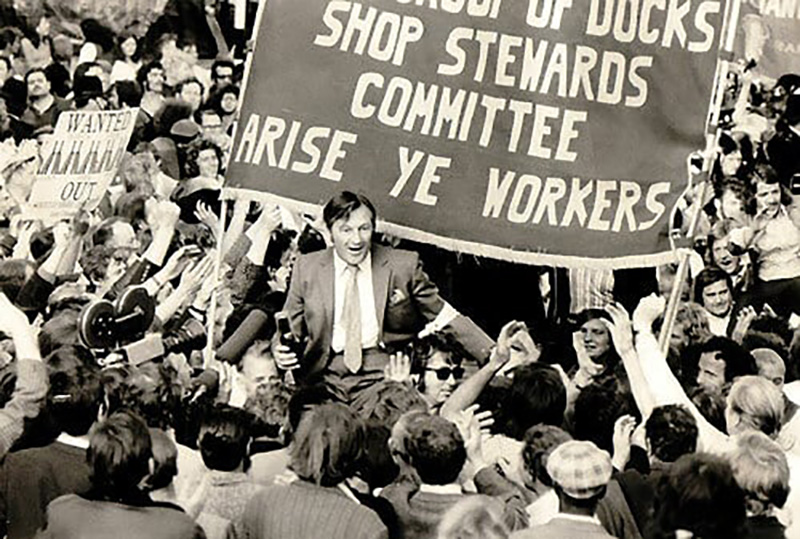
- 1971: The First Open Assault. Heath’s Industrial Relations Act was the bludgeon. It tried to legally outlaw effective strike action. Its defeat—by the mass, illegal action of the dockers and the wider class—was a glorious moment. It proved bourgeois law could be broken. But it also taught the ruling class a lesson: they needed a smarter, more gradual strategy to win.

The Thatcher Project: The Battle is Won By The Ruling Class (1980-1993)
Thatcher didn’t just pass laws. She executed a military-style campaign to split, besiege, and neutralise the working class.
- Cut the Lines of Solidarity (1980-82 Acts): The outlawing of secondary action was a masterstroke for capital. It turned every dispute into an isolated siege. It legally enforced the principle of “divide and conquer,” preventing workers at a supplier or a customer from legally supporting a strike. This shattered the fundamental trade union principle of class solidarity.
- Bureaucratise the Strike (1984-93 Acts): This was the insidious follow-up. By mandating impossible ballot thresholds, long notice periods, and complex rules, they turned the strike from a weapon into a regulated administrative procedure. The goal was twofold: trap militants in a web of legal technicalities, and empower the more conservative, bureaucratic layers of the union officialdom who would police their own members to avoid court fines. The defeat of the miners—starved, isolated, and battered by the state—was the pivotal battle that broke the working class’s front line.
New Labour’s Betrayal: Managing the Victor’s Peace (1997-2010)
Here is the heart of it. Blair and Brown didn’t fail to change things. They consciously ratified the surrender.
- The “Third Way” Was Class Collaboration. They framed it as modernisation. We must name it: it was the ideology of permanent concession. It accepted globalised capital’s terms as unchallengeable and told workers their only hope was to be “flexible” and attract investment. This wasn’t a government trying to shift power; it was a management consultancy for the Thatcher settlement.
- Rights for Individuals, Chains for the Class. Their legacy—the minimum wage, working time rules—is important. But understand its function. These were palliatives, safety valves granted from above to the individual worker-as-consumer. They slightly raised the floor of exploitation while leaving the ceiling of capitalist power untouched. Meanwhile, they explicitly refused to repeal the laws that crippled our collective power. They made the shackles bipartisan. They gave us a slightly better cage and threw away the key.
- The Corruption of “Partnership”. This era exposed the deep rot within the trade union bureaucracy. Seduced by access to ministers and “social partnership,” much of the leadership swapped militancy for a seat at the table. They became managers of discontent, channelling anger into focus groups and consultations while the fundamental architecture of our weakness remained. They were paid to police their own side.
The Path Isn’t Through Their Parliament But Through Workers Power
This history leaves us with a brutal clarity.
The Labour Party is not a vehicle for working-class power and never was. It is a wholly pro-capitalist party staffed by class traitors and petit bourgeois social climbers. Its historic mission is to manage capitalism, and when required, to manage the defeat of the working class in order to preserve the system.
Therefore, our task is not to lobby for kinder governors. It is to build independent, militant class power that exists outside and against the parliamentary circus.
- We must build unions that are willing to defy the anti union laws, to reclaim the weapon of solidarity action and make the anti-union laws unenforceable through mass action.
- We must fight within our unions to break the stranglehold of the collaborationist bureaucracy and build rank-and-file power.
- We must direct our energy not towards electing the next friendly manager of our decline, but towards constructing real, counter-power in our workplaces and communities.
The battle isn’t for a better deal within capitalism. It’s about which class holds power. It is a straight forward case of us or them, the bourgeoisie. They are remorseless in their attacks on us and we must be able to respond properly not have our hands tied by the bureaucratic traitors who mislead the union movement.
Leave a Reply